Why Silicone Sealant Outperforms Traditional Caulk on Flashing Joints
When Silicone Roof Flashing Sealant Makes Sense
Use silicone roof flashing sealant on a clean, compatible joint that must flex as the roof expands and contracts. Unlike traditional caulk, roofing-grade silicone stays flexible through Columbus heat, winter cold, and UV exposure. Choose a product approved for your roof material, remove loose sealant and debris, and follow its directions for surface prep and curing.
Silicone is not the right fix for every leak. A loose or damaged piece of flashing may need repair, and other roof coatings can be hard to apply over silicone later. I'm Chad M. Baker, a third-generation owner of JF Baker Roofing, which has served Central Ohio since 1929.
Simple guide to silicone roof flashing sealant:
Why Silicone Roof Flashing Sealant Outperforms Traditional Sealants
Roof flashings protect the most vulnerable intersections of any roofing system. These transitions, located around chimneys, walls, valleys, and vent pipes, constantly endure structural movement. As outdoor temperatures rise and fall, the dissimilar building materials attached to these joints expand and contract at different rates. Metal flashings expand rapidly in direct sunlight, while underlying wood framing or masonry walls move at a much slower pace.
This physical reality means flashing joints are under continuous stress. When property owners rely on standard caulking for flashing, the joint often fails prematurely. Traditional water-based or solvent-based caulks harden and lose their elasticity after a few seasons of harsh weather. Once a sealant becomes brittle, the natural shearing motion of the roof pulls the bond apart, creating micro-fissures that allow moisture behind the flashing.
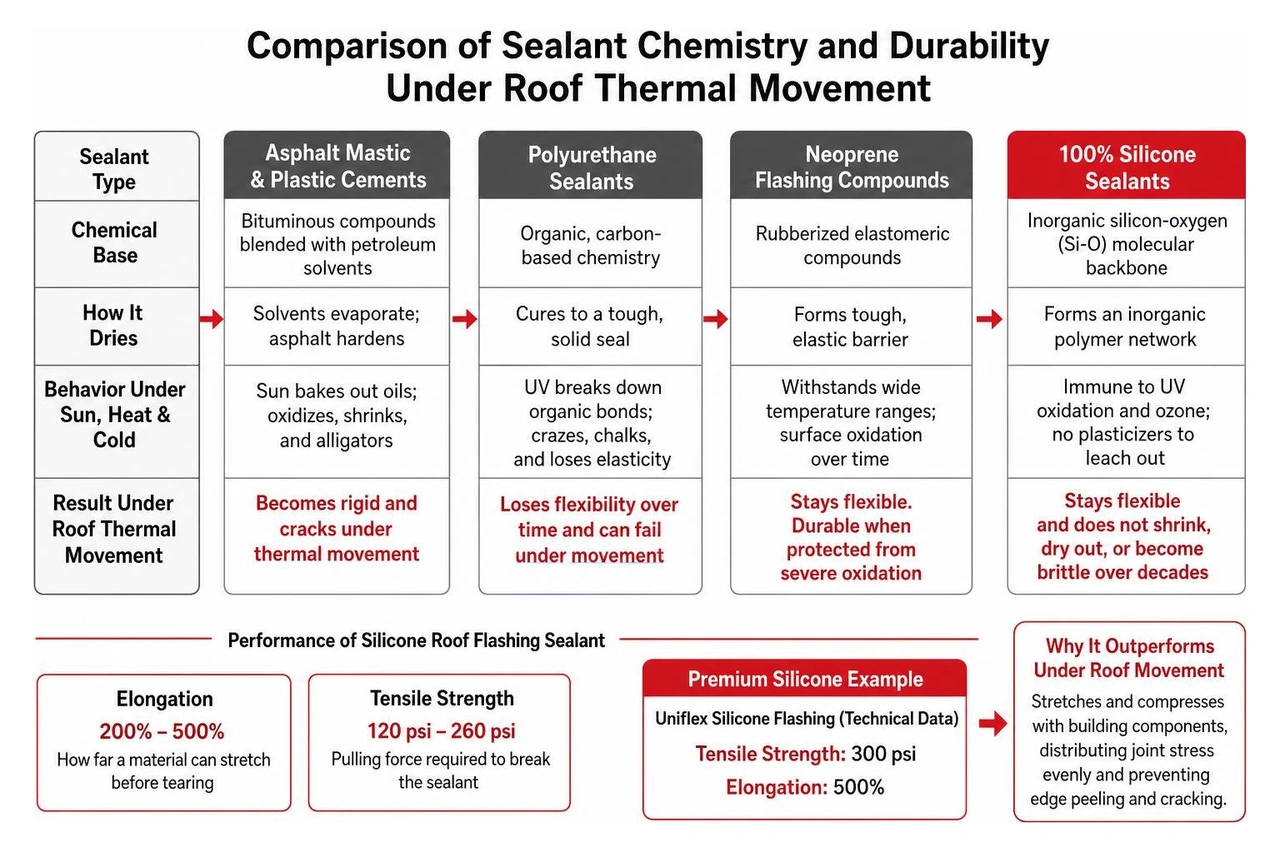
Silicone elastomeric chemistry solves this fundamental problem. Instead of drying through simple evaporation, flashing-grade silicone forms an inorganic polymer network that stays permanently elastic. It stretches and compresses with the building components rather than tearing away from the substrate. By distributing joint stress evenly across the bond line, silicone prevents the edge peeling and cracking that plague older sealant formulas.
Chemical Formulations: Silicone vs Polyurethane, Neoprene, and Asphalt
Understanding how different roof repair materials behave over time comes down to their base chemistry. Every product category offers unique characteristics, but their long-term stability varies widely when exposed to the elements.
- Asphalt Mastic and Plastic Cements: Traditional asphalt roofing cements rely on heavy bituminous compounds blended with petroleum solvents. As the volatile solvents evaporate, the asphalt hardens. Prolonged exposure to sunlight bakes the remaining oils out of the material, causing it to oxidize, shrink, and alligator. While asphalt cements are inexpensive for quick patches, their rigid nature means they quickly crack under thermal movement.
- Polyurethane Sealants: A high-grade polyurethane roof sealant provides excellent initial adhesion and solid abrasion resistance. However, polyurethane contains organic carbon-based chemical bonds. Over multiple seasons of intense solar radiation, ultraviolet rays break down these organic bonds, which can cause the polyurethane surface to craze, chalk, and lose its elasticity.
- Neoprene Flashing Compounds: Heavy-duty rubberized products like APOC 501 Super-Flash Neoprene Flashing Sealant are formulated to create tough, elastic barriers capable of withstanding wide temperature ranges. These elastomeric compounds excel in heavy-duty emergency situations and can endure decades of thermal movement when properly protected from severe surface oxidation.
- 100% Silicone Sealants: Silicone features an inorganic silicon-oxygen (Si-O) molecular backbone. Because this bond requires significantly more energy to break than organic carbon bonds, silicone is naturally immune to UV oxidation and ozone breakdown. It does not contain volatile plasticizers that can leach out over time, ensuring the material will not shrink, dry out, or become brittle over decades of service.
Elongation and Tensile Strength of Silicone Roof Flashing Sealant
Two primary mechanical properties determine how well a sealant performs on a moving roof: elongation and tensile strength. Elongation measures how far a material can stretch before tearing, while tensile strength measures the pulling force required to break it.
Standard silicone roof sealants typically provide between 200% and 500% elongation, paired with tensile strength ratings between 120 psi and 260 psi. Premium formulations engineered for heavy commercial and residential flashing work demonstrate even greater resilience. For instance, Uniflex Silicone Flashing technical data indicates a tensile strength of 300 psi and an elongation capability of 500%.
These technical metrics translate directly to reliable real-world performance. When winter temperatures plunge and metal flashings contract, a sealant with 500% elongation stretches smoothly across the widened joint without splitting down the middle or pulling away from the substrate. Furthermore, high tensile strength ensures the cured rubber withstands wind-driven debris, heavy snow loads, and joint shear forces without tearing.
Environmental Resilience: UV Exposure, Temperature Swings, and Standing Water
Roof surfaces experience the harshest environmental conditions of any part of a building. In Central Ohio, roofs endure sweltering summer heat waves, high humidity, freezing winter storms, and frequent freeze-thaw cycles. Sealants that rely on organic polymers degrade under these fluctuating conditions, but silicone's unique chemical structure provides an exceptional defense against natural weathering.
UV Stability and Thermal Resistance Across 2026 Climate Extremes
Solar radiation is the primary cause of roof sealant failure. Ultraviolet rays break weak molecular bonds in common caulks, turning flexible beads into hard, chalky residues. Silicone remains chemically stable under intense UV exposure because its inorganic silicon-oxygen backbone is unaffected by solar radiation. It will not yellow, chalk, crack, or peel, even on unshaded southern roof exposures.
Thermal stability is equally vital. Silicone roof flashing sealant maintains its elastomeric properties across an exceptionally wide operating temperature range. Whether the roof surface reaches 160°F during a mid-summer afternoon or drops well below zero during a January freeze, silicone retains its original flexibility. This thermal resilience prevents seasonal thermal shock from ripping the sealant bead apart at critical joints.
Ponding Water Performance and Joint Integrity
Many flat and low-slope roof transitions develop areas of standing or ponding water after heavy rains. Water that sits on a roof for 48 hours or more quickly breaks down traditional water-based acrylics and emulsifies standard asphalt patches, leading to premature leaks.
Silicone is naturally hydrophobic and completely moisture-cured. Once fully cross-linked, it will not soften, swell, or undergo chemical reversion when submerged under standing water. This water resistance makes silicone an outstanding choice for sealing vent pipe flashing penetrations, low-slope parapet walls, and internal roof gutter troughs where drainage may be slow.
Best Practices: Step-by-Step Installation and Safety Protocols
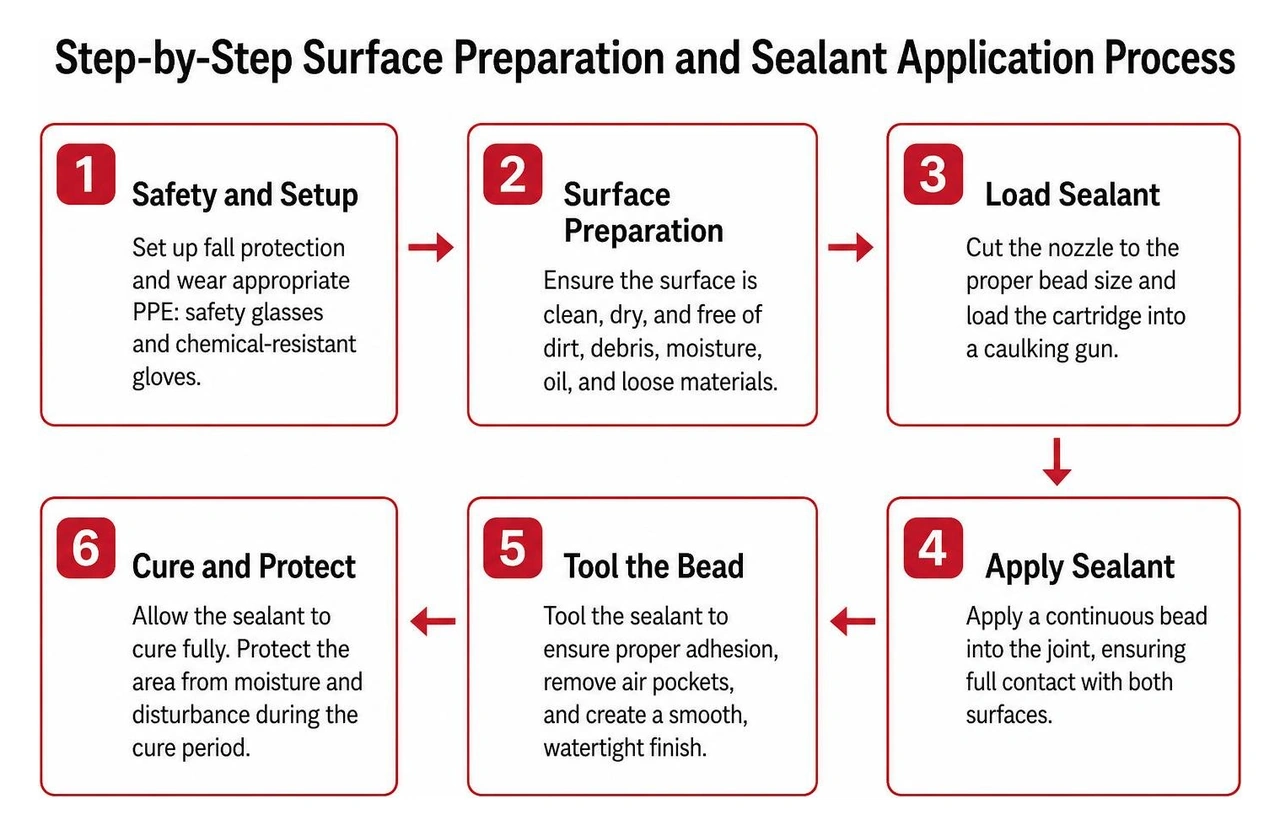
Even the most advanced silicone sealant will fail if applied over a dirty or poorly prepared substrate. Professional roofers follow strict installation protocols to guarantee that the chemical bond holds against decades of weather exposure.
Step-by-Step Application of Silicone Roof Flashing Sealant
Achieving a permanent, waterproof seal requires careful attention to surface preparation, ambient conditions, and tooling techniques:
- Safety and Setup: Before starting, set up proper fall protection and wear appropriate personal protective equipment, including safety glasses and chemical-resistant gloves. Working with silicone requires clean handling, as uncured material transfers easily to clothing and surrounding roof surfaces.
- Surface Cleaning: Remove all traces of failed prior caulks, asphalt mastics, rust, moss, and loose debris. A wire brush or scraper works well on metal and masonry. For general surface contaminants, clean the area with denatured alcohol or mineral spirits to remove oily residues, then wipe the area completely dry with a clean cloth.
- Adhesion Testing: If you are bonding to an uncommon or previously coated substrate, apply a small test bead of sealant in an inconspicuous area. Allow it to cure fully, then perform a manual pull test to confirm strong adhesion before proceeding with the entire repair.
- Temperature Verification: Ensure the ambient and surface temperatures fall within the recommended application range. Most silicone sealants, including Uniflex formulations, perform best when installed between 35°F and 100°F. Avoid applying sealant if freezing frost is actively forming on the substrate.
- Dispensing and Tooling: Apply a continuous, uniform bead of sealant directly over the flashing joint, ensuring full contact with both surfaces. For wider patches or seams, products like the GacoPatch silicone roof patch documentation outline single-step applications using a brush, trowel, or sausage gun without requiring separate fabric reinforcement on horizontal repairs up to a half-inch thick. Tool the bead immediately using a dry putty knife or gloved finger to press the sealant firmly into the joint and create a smooth, water-shedding profile.
- Cleanup: Clean tools and remove excess uncured silicone immediately using mineral spirits or denatured alcohol. Once silicone cures, it cannot be dissolved by solvents and must be mechanically cut or scraped away.
Damp Surface Application and Rapid Cure Windows
Standard caulks require bone-dry conditions to achieve a bond, making emergency leak repairs during wet weather nearly impossible. Many modern flashing-grade silicone formulations are moisture-curing, which allows them to utilize ambient humidity to accelerate the vulcanization process.
High-grade products like KARNAK 671 Karna-Seal achieve rain safety in as little as one hour, preventing wash-off from unexpected storms. Other fast-curing sealants, such as Kool Seal Silicone Flashing Sealant, become tack-free in approximately 30 minutes and achieve a full cure within 24 hours under standard humidity levels. Formulations like GacoPatch are engineered to bond directly to damp substrates once standing water is squeegeed away, providing a reliable option for stopping active moisture intrusion during emergency service calls.
Substrate Compatibility and Critical Recoating Limitations
Silicone is exceptionally versatile, but it is not a universal cure-all for every roofing condition. Understanding where silicone bonds well, and recognizing its long-term limitations, is essential for preserving the integrity of your overall roof system.
Performance on Metal, EPDM, TPO, and Masonry Transitions
Roof flashings create junctions between diverse materials. A single flashing detail might require bonding sheet metal to brick, or connecting single-ply membranes to concrete parapets.
- Sheet Metal and Gutters: Neutral-cure silicone formulations, such as FulaSeal 700, are ideal for galvanized steel, aluminum, copper, and stainless steel. Because neutral-cure silicones do not release acetic acid during vulcanization, they protect metal surfaces against corrosion.
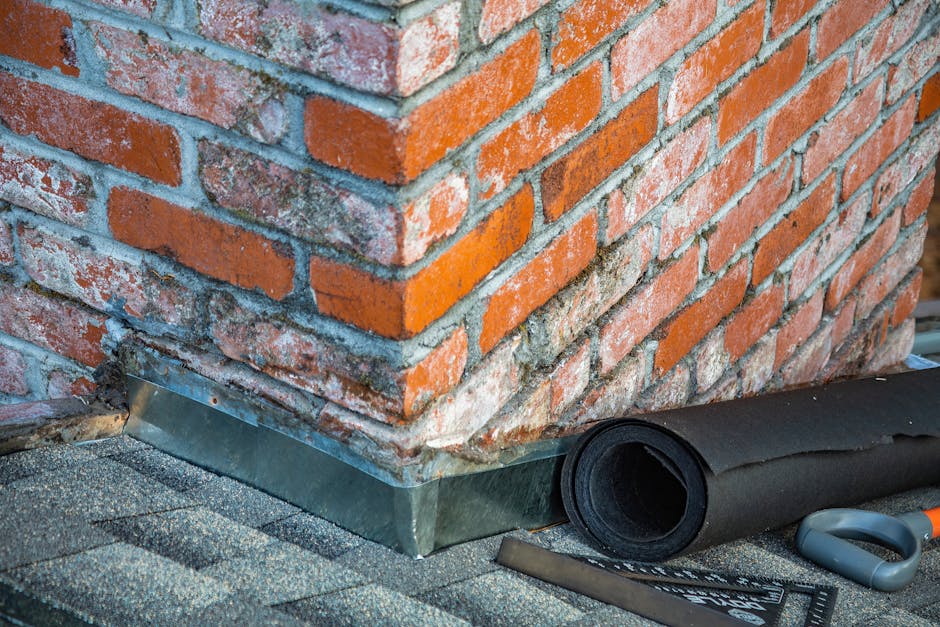
- Masonry and Brick: When executing chimney flashing leak repairs, silicone bonds securely to porous brick, mortar joints, and stone counter-flashings, providing a weather-tight seal that accommodates building settlement.
- Single-Ply Membranes (EPDM, TPO, PVC): Silicone adheres exceptionally well to aged EPDM rubber membranes. However, when working on TPO or PVC roofs, caution is necessary. Fresh TPO and PVC contain processing oils and plasticizers that can hinder adhesion. While aged single-ply roofs (generally four years or older) bond well after thorough cleaning with denatured alcohol, newer single-ply membranes often require a dedicated manufacturer primer to ensure a permanent bond.
The "Silicone-Only" Recoating Dilemma
The greatest technical advantage of silicone is also its most significant long-term limitation. Silicone cures into an inert, low-surface-energy rubber. Practically speaking, almost nothing sticks to cured silicone except fresh silicone.
If you apply silicone sealant across flashing joints on an asphalt shingle roof, a modified bitumen system, or a metal roof, you cannot later apply traditional acrylic, polyurethane, or asphalt coatings over those repairs. Any future liquid-applied coating will bead up, fail to adhere, and peel away from the silicone patches.
Before using silicone on extensive roof areas, property owners must consider their long-term maintenance strategy. If you plan to apply a full elastomeric acrylic coating across your roof in the future, standard silicone repairs will interfere with that project. In those scenarios, using a compatible metal flashing sealant or a high-grade polyurethane sealant may be the wiser strategic choice. When silicone is selected, future maintenance on those joints must be performed using dedicated silicone products.
Frequently Asked Questions About Roof Flashing Sealants
What makes silicone sealant better than asphalt roof cement for flashing joints?
Asphalt roof cement relies on solvent evaporation to cure, leaving behind a rigid bituminous material that oxidizes and becomes brittle under sunlight. Within a few seasons, normal thermal expansion and contraction cause asphalt cement to crack and pull away from metal flashings. Silicone sealant features an inorganic silicon-oxygen chemical structure that is completely immune to UV degradation. It maintains 200% to 500% elongation across extreme hot and cold temperatures, providing a flexible seal that lasts for decades without drying out or cracking.
Can silicone roof flashing sealant be applied over damp surfaces during an active leak?
Certain flashing-grade silicone sealants are specifically formulated for damp-surface application during emergency repairs. Because silicone is a moisture-curing polymer, it utilizes environmental humidity to complete its cross-linking process. While standing water should always be brushed or squeegeed away from the joint, products like GacoPatch bond securely to damp metal, masonry, and membrane surfaces without requiring a primer, creating a rain-safe seal in as little as one to two hours.
Why is it difficult to apply other roof coatings over silicone sealant later?
Cured silicone creates a very low-surface-energy, non-stick finish that prevents other chemical compounds from establishing a mechanical or chemical bond. Traditional roof coatings, including water-based acrylics, solvent-based SEBS polymers, and asphalt emulsions, cannot adhere to a silicone surface and will peel away upon drying. Once silicone is applied to a flashing joint or roof seam, any future maintenance or recoating on that specific area must be performed using compatible silicone-based products.
Conclusion
Choosing the right sealant for your roof flashings makes the difference between a lasting, watertight repair and recurring interior water damage. While traditional caulks and asphalt mastics dry out and crack under seasonal weather extremes, high-performance silicone remains permanently flexible, UV-stable, and resistant to ponding water. For a broader look at flashing maintenance strategies, explore our roof flashing sealant guide 2026 or learn more about preserving your roofing system through routine roof maintenance.
At JF Baker Roofing, we have been serving Central Ohio property owners since 1929. Led by third-generation owners Chad and Pat Baker, our family-owned company is built on integrity and proven by performance. We are a CertainTeed ShingleMaster Preferred Contractor, an NRCA member, and a BBB Accredited Business with an A+ rating.
We provide residential roofing, commercial roofing, roof repair, roof replacement, storm damage roofing, gutter installation and repair, and custom sheet metal work across Columbus and surrounding communities, including Dublin, Upper Arlington, Hilliard, Grandview Heights, Worthington, and Westerville. Our crews provide honest assessments with no high-pressure sales tactics, recommending cost-effective repairs when repairs suffice and full replacement only when genuinely needed.
If you suspect a flashing leak or need a professional assessment of your roof transitions, contact our team today to schedule an inspection. Let our reputation be your security.