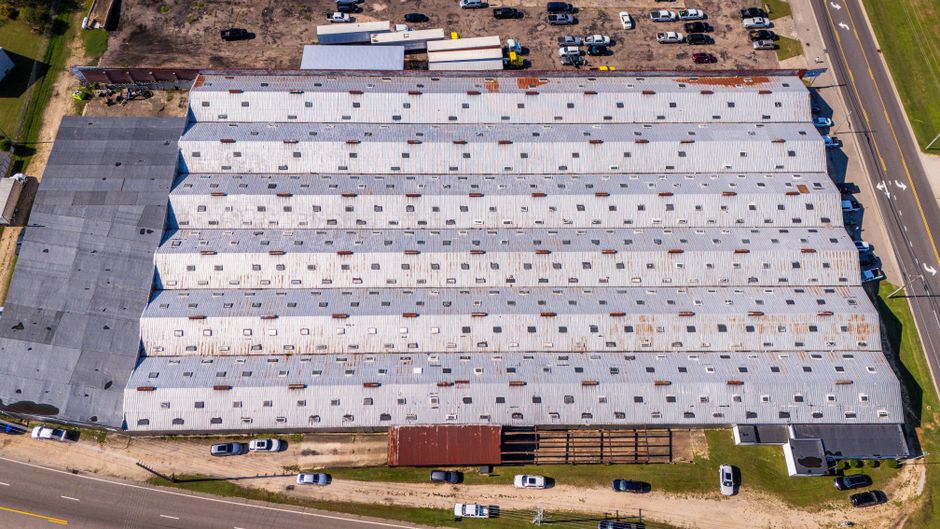
Commercial Flat Roof Maintenance Strategies That Prevent Premature Failure
The True Cost of Neglect vs. Proactive Flat Roof Care
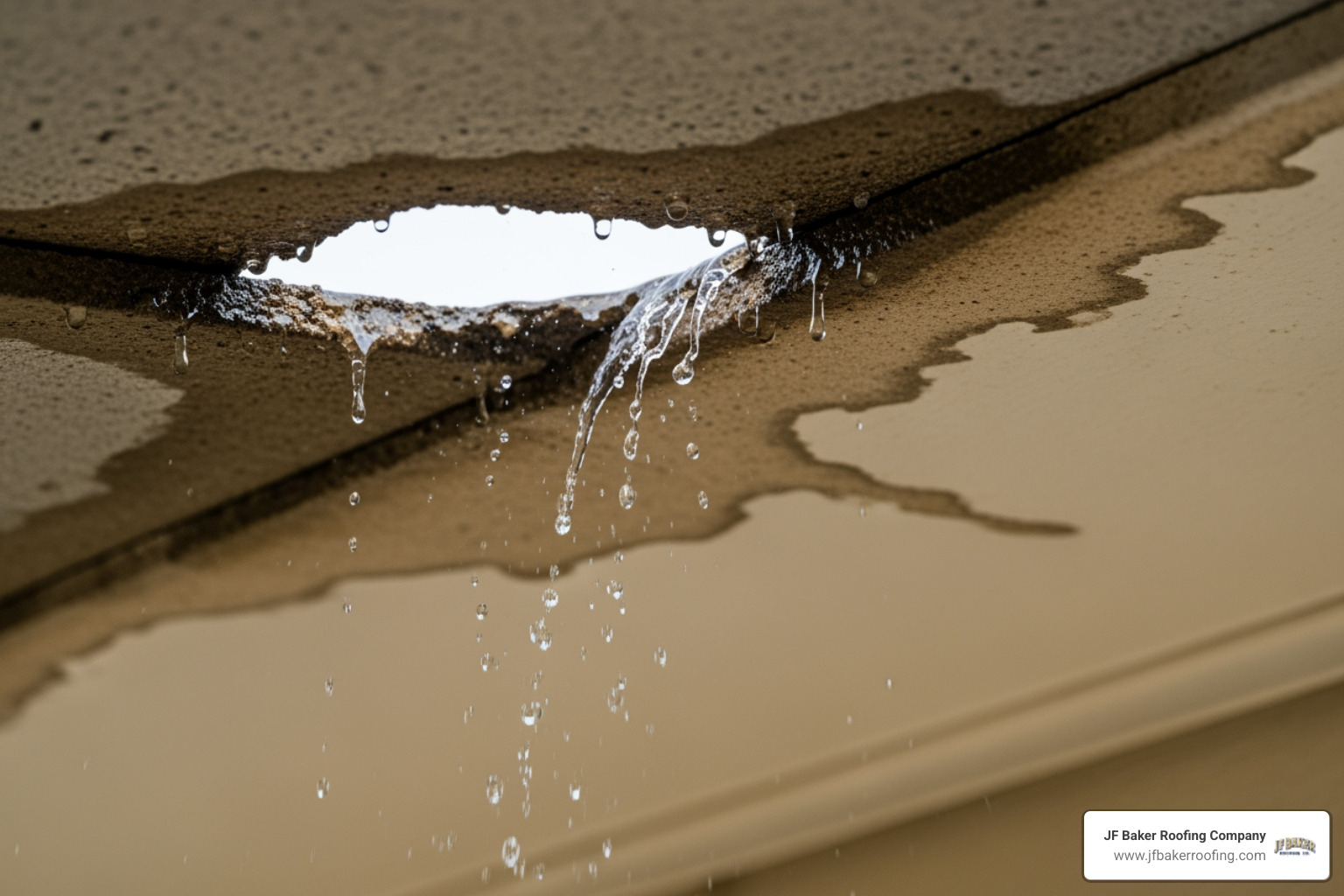
Effective commercial flat roof maintenance starts with a few core strategies: schedule professional inspections twice a year, keep drains and scuppers clear, maintain flashings and sealants around every penetration, and probe seams for early signs of separation. These steps prevent minor surface defects from becoming structural vulnerabilities. A low-slope roof functions as a complete protective envelope, and when regular care is neglected, moisture intrusion does not simply stay on top of the membrane. Once water penetrates an unsealed seam or compromised flashing detail, it enters the underlying insulation. Saturated polyisocyanurate (ISO) board loses its thermal resistance, driving up building heating and cooling bills long before water drips onto the warehouse or office floor. Trapped water also rusts metal decking, rots wood substrates, and deteriorates concrete decks from the top down.
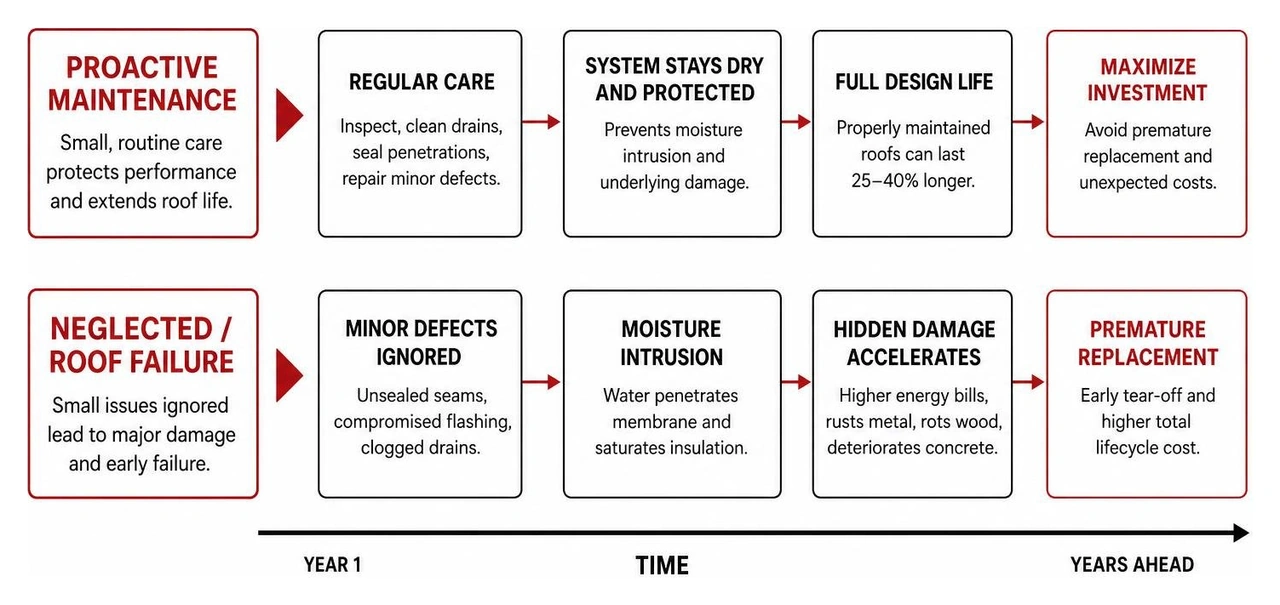
Proactive property care fundamentally changes this dynamic. Data from the National Roofing Contractors Association (NRCA) shows that properly maintained commercial roofs can last 25 to 40 percent longer than neglected systems. Instead of facing an unexpected total tear-off years ahead of schedule, facility owners who follow a structured commercial roof maintenance program capture the full design life of their investment.
Eliminating Ponding Water and the 48-Hour Rule
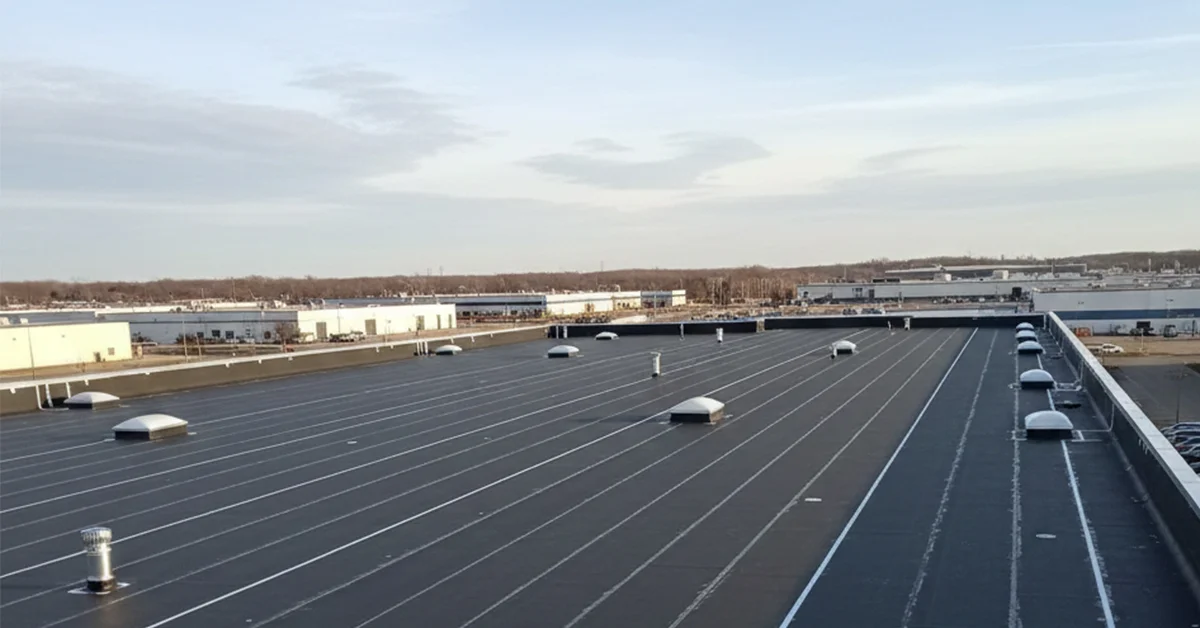
Low-slope commercial roofs are designed to shed water efficiently toward designated outlets. However, settling decks, clogged strainers, or insufficient slope can allow water to pool in low sections.
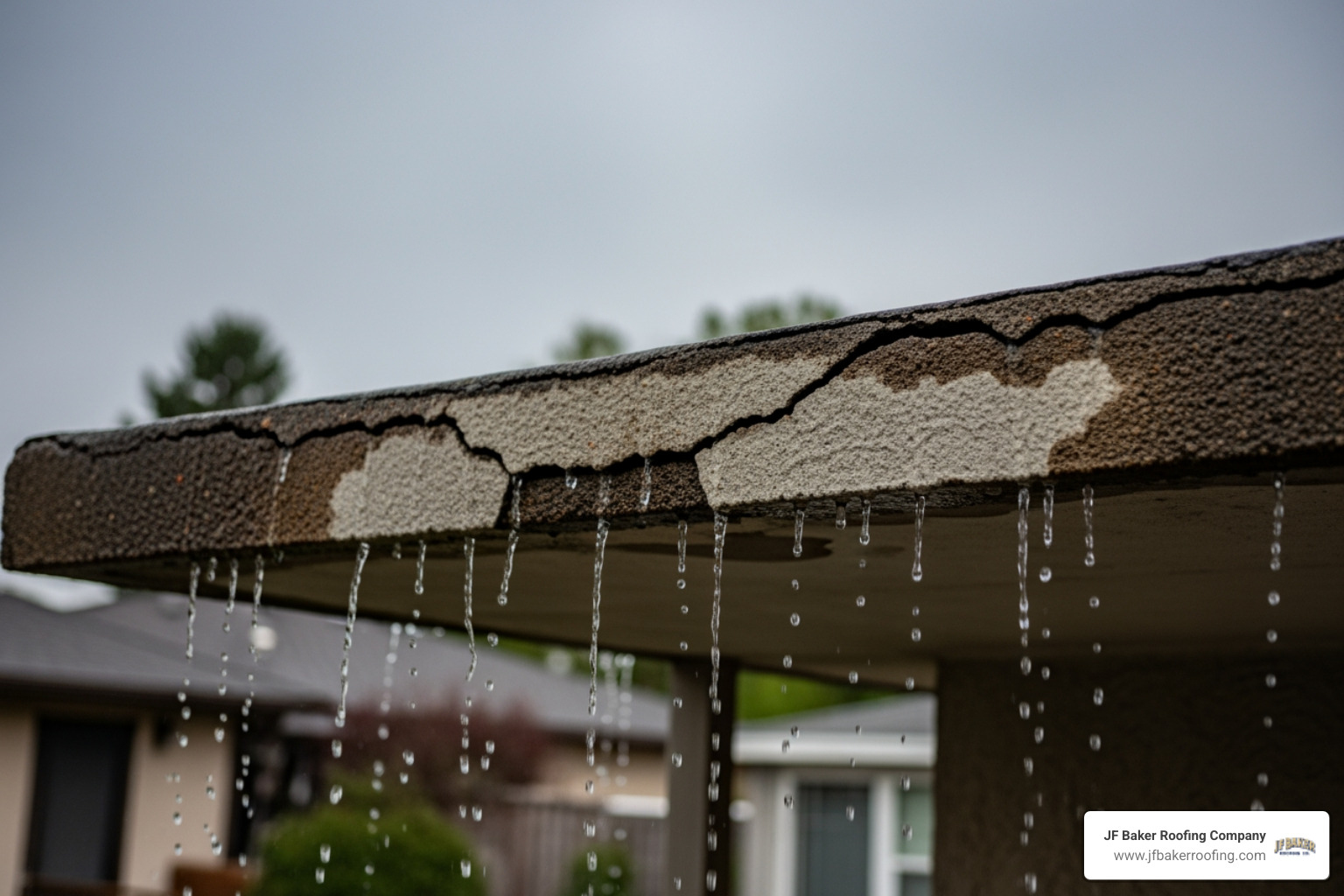
In the commercial roofing industry, the standard benchmark is the 48-hour rule. Any standing water remaining on a flat roof membrane 48 hours after rain ends qualifies as ponding water. Standing water creates multiple severe hazards:
- Hydrostatic Pressure: Continuous water weight exerts constant downward force, exploiting pinholes or micro-fissures in aged seams.
- Structural Deflection: A single inch of ponding water weighs roughly 5.2 pounds per square foot. Over a large depression, this added load sags roof decking, creating deeper valleys that hold even more water.
- Biological Accumulation: Standing water collects dirt, algae, vegetation, and airborne seeds, which trap moisture against the membrane and break down protective coatings.
- Freeze-Thaw Deterioration: In Central Ohio winters, standing pools freeze into solid ice lenses. As water expands upon freezing, it exerts mechanical stress against flashings, scuppers, and welded seams.
Eliminating ponding requires keeping drainage pathways open, adding auxiliary drains, or installing tapered insulation saddles to redirect flow toward existing outlets.
Budgeting for Commercial Flat Roof Maintenance and Warranty Compliance
Treating your commercial roof as an asset rather than an emergency expense requires an annual maintenance reserve. A practical rule of thumb is setting aside 1.5 to 2 percent of the roof's total replacement value each year for routine inspections, minor caulking, drain cleaning, and preventive patching.
Consistent upkeep is also critical for legal warranty compliance. Most manufacturer No Dollar Limit (NDL) warranties explicitly mandate documented semi-annual inspections and routine housekeeping. If an internal leak occurs and the building owner cannot produce service records showing bi-annual drain cleaning and professional evaluations, the manufacturer can deny coverage for moisture damage. A disciplined schedule safeguards your warranty rights and prevents premature capital spending.
Essential Commercial Flat Roof Maintenance Protocols
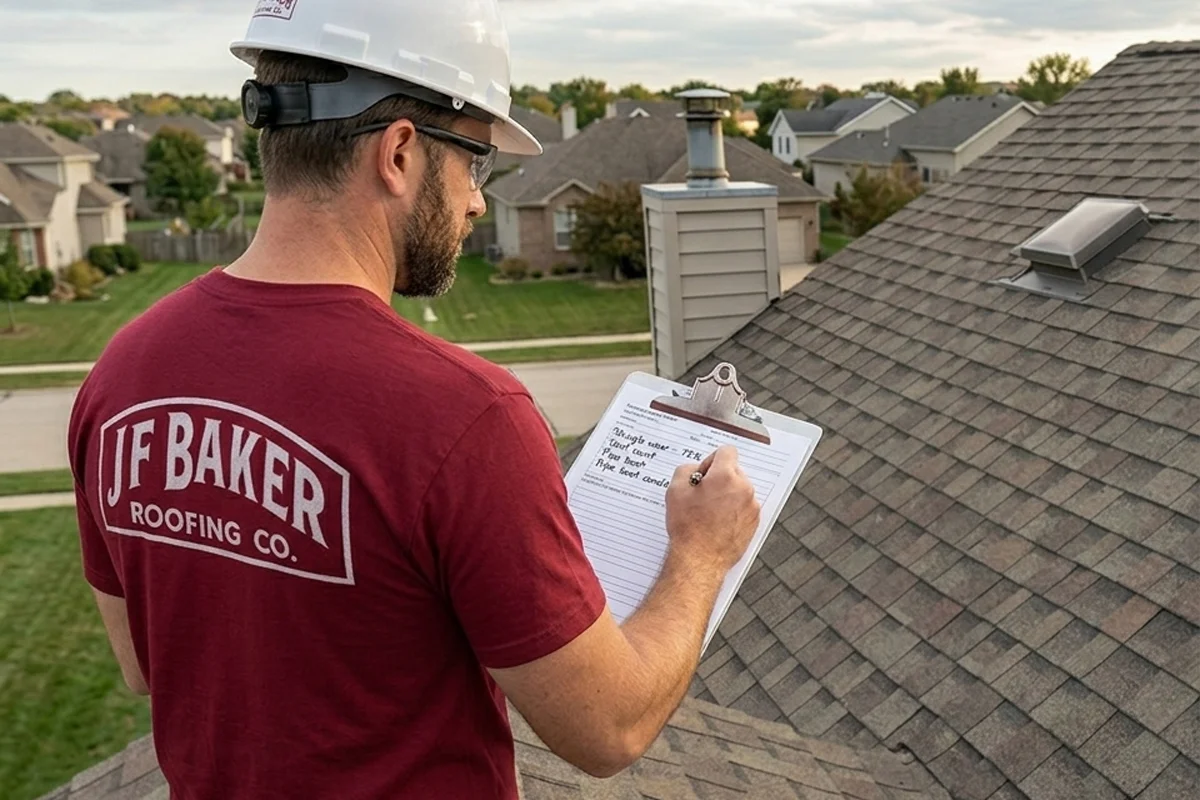
A comprehensive commercial upkeep program relies on a predictable cadence: professional evaluations in the spring to evaluate winter stress and in the fall to prepare for freezing weather. Supplementary visual walkthroughs should take place within 48 hours following severe storms, hail events, or extensive rooftop HVAC servicing. Scheduling a routine roof inspection establishes an ongoing baseline of membrane condition over time.
Drainage, Scupper, and Gutter Upkeep
Improper drainage remains a primary contributor to premature low-slope roof issues. Keeping water moving requires targeted inspection of all drainage components:
- Internal Drain Basins: Remove accumulated leaves, silt, and foreign objects from the clamping rings and cast-iron drain domes. Ensure strainer baskets are seated firmly to prevent pipes from clogging below the deck.
- Through-Wall Scuppers: Check that scupper openings along parapet walls are clear of gravel, trash, or bird nests. Verify that exterior downspouts are tightly fastened.
- Overflow Drains and Scuppers: Ensure secondary overflow openings, positioned two to four inches above primary drains, remain unobstructed to prevent catastrophic deck overload if primary lines back up.
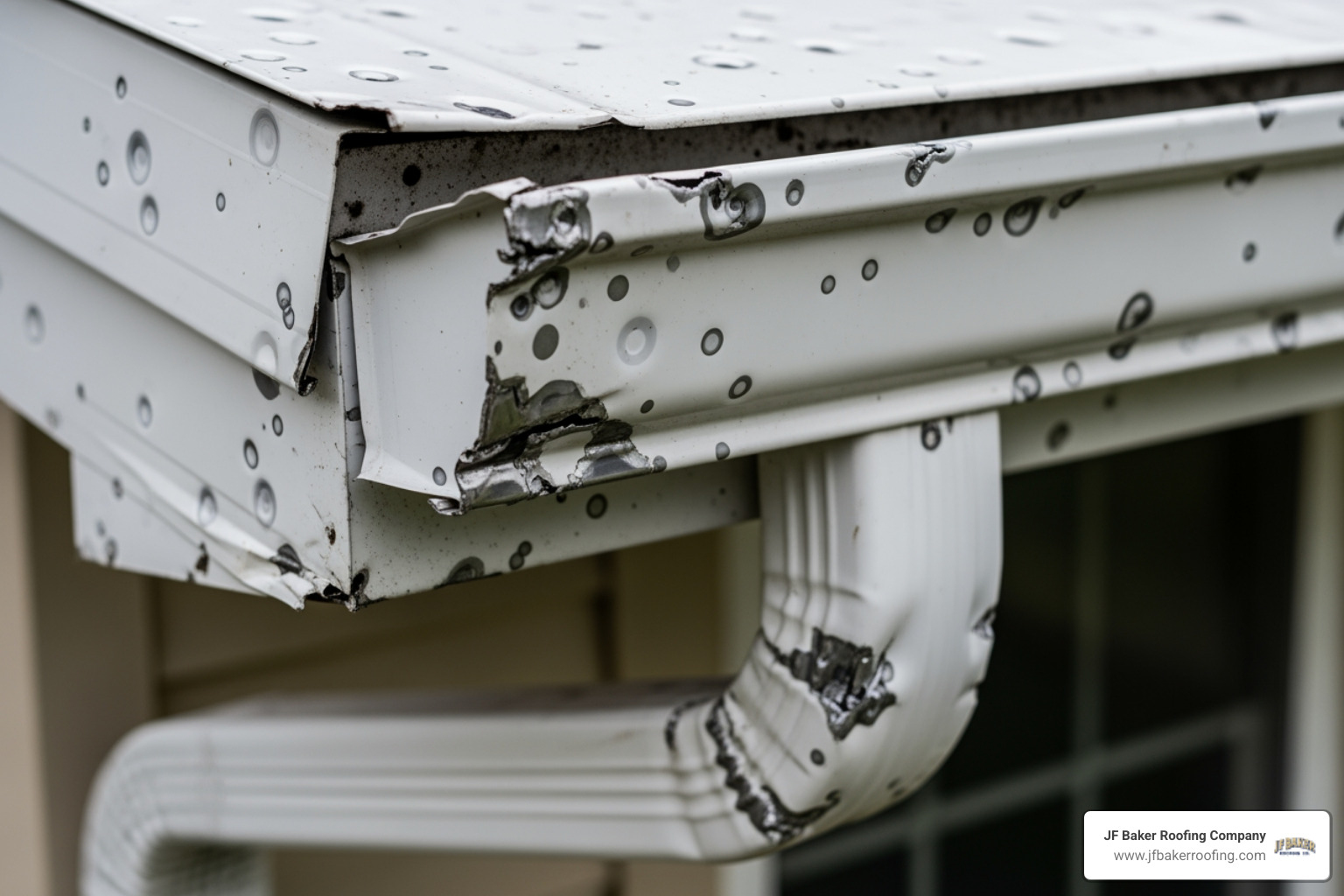
- Commercial Gutters: Clean out external gutter troughs along roof edges and inspect brackets to ensure winter ice loads have not pulled them out of alignment.
Flashing, Sealant, and Penetration Maintenance
More than 80 percent of commercial flat roof leaks originate at flashings and penetrations rather than within the open membrane field. Every pipe, vent, HVAC curb, and parapet wall represents an interruption in the continuous roofing plane.
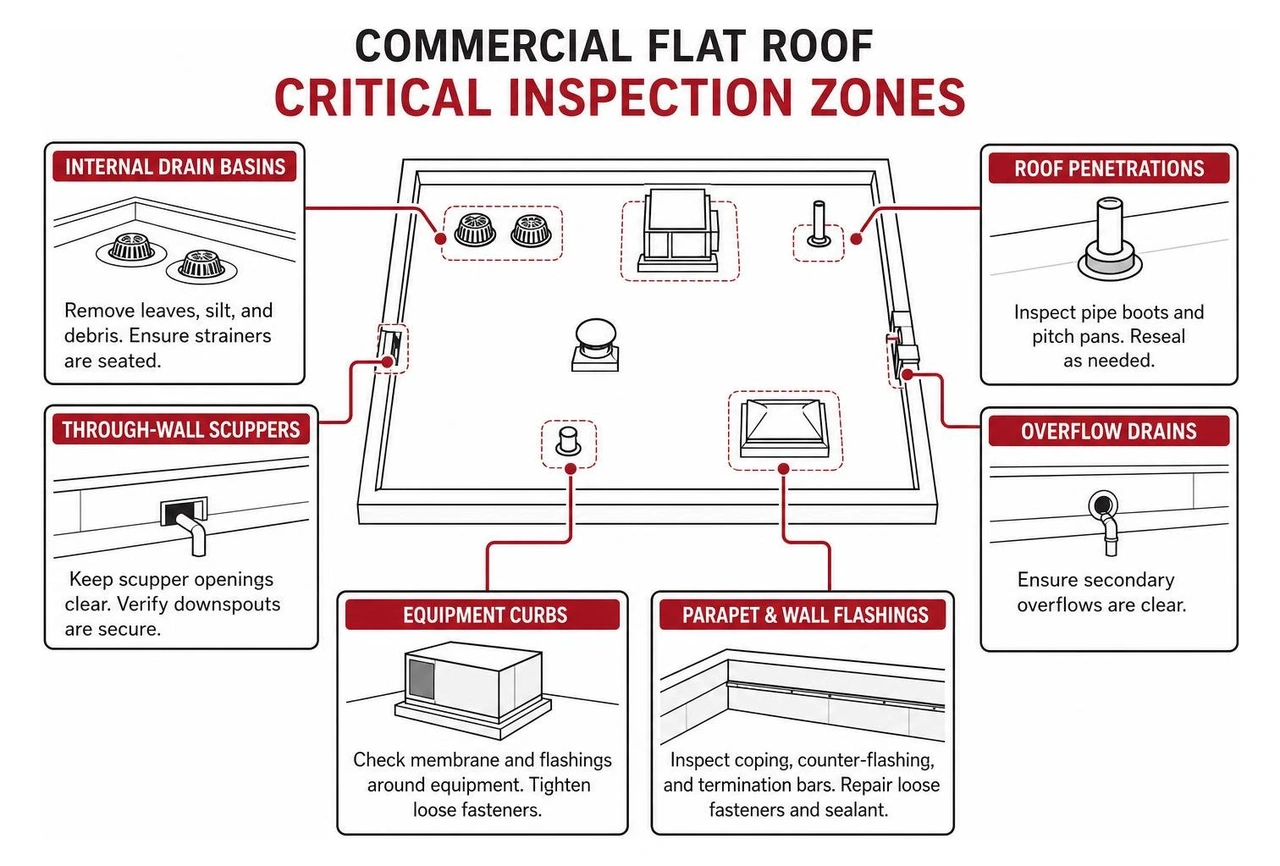
During each inspection, technicians examine:
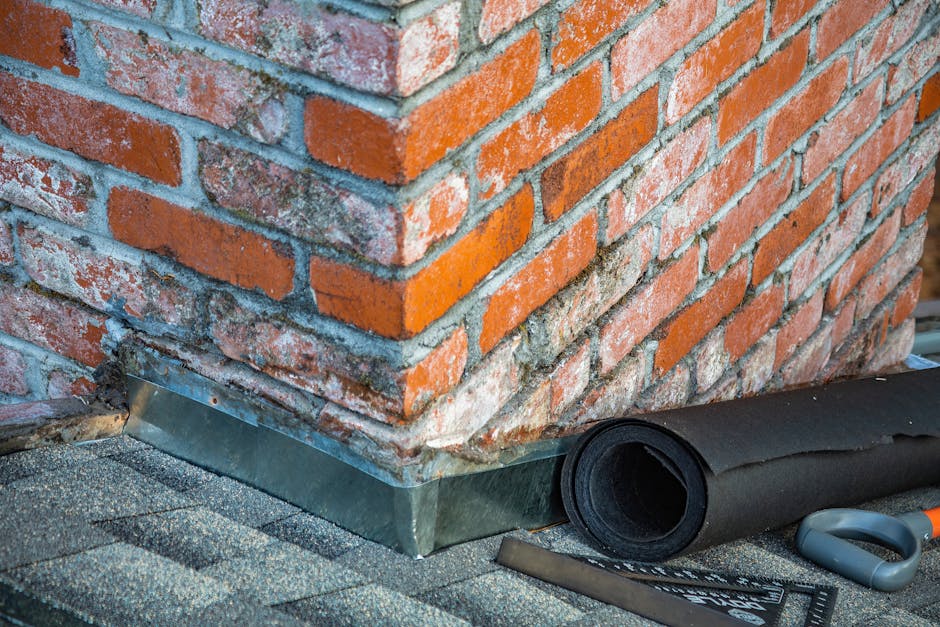
- Parapet Wall Terminations: Inspect coping metal joints, counter-flashing reglets, and termination bars for loose mechanical fasteners or failed sealant beads.
- Equipment Curbs: Check the membrane wrapping around rooftop air handlers, exhaust fans, and skylights. Vibration from running equipment can loosen unreinforced flashings over time.
- Pitch Pans and Pipe Boots: Pitch pockets filled with pourable sealer dry out, shrink, and crack under ultraviolet exposure. These require topping off with compatible elastomeric compounds every few years.
- Thermal Expansion Joints: Commercial buildings expand and contract through seasonal temperature shifts. Confirm expansion joint covers remain flexible and well anchored.
Membrane Integrity and Seam Probing
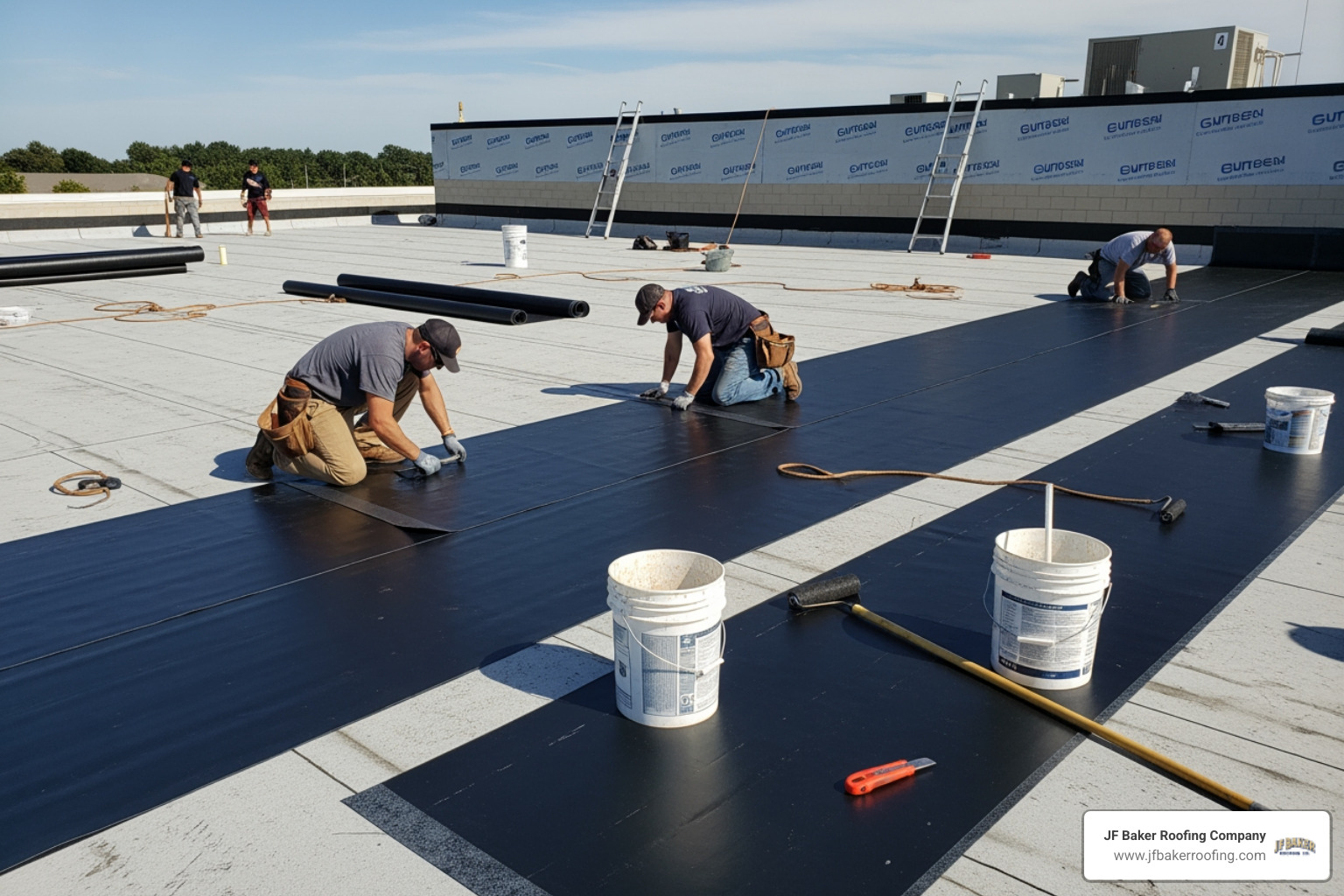
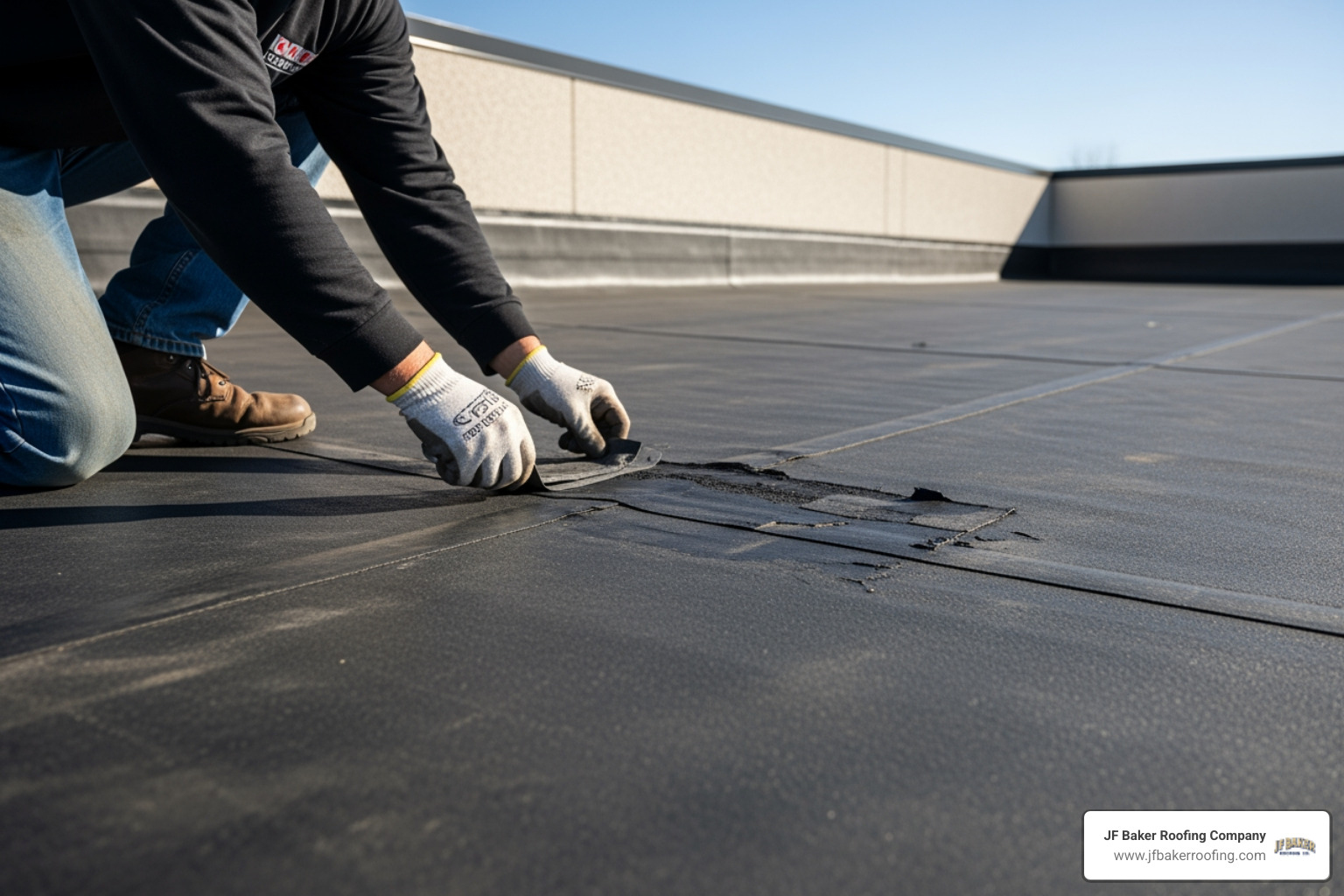
The field of the roof requires hands-on evaluation. Roofing professionals use a blunt cotter-pin puller or seam probe along membrane laps to identify unbonded edges without cutting the material.
Field checks also involve locating membrane punctures caused by dropped tools, loose screws left by mechanical crews, or windblown debris. High-traffic paths leading from roof access hatches to mechanical units must be reinforced with heavy-duty walk pads. Without sacrificial walkways, maintenance technicians servicing HVAC filters and compressors can quickly wear down the waterproofing membrane. For an overview of specialized membrane care, property owners can reference practical resources like Flat Roof Maintenance: Special Care Requirements 2026.
Membrane-Specific Strategies: EPDM, TPO, and Modified Bitumen
Different single-ply and multi-ply membranes react differently to weather, foot traffic, and aging. Customizing your maintenance approach to your specific membrane chemistry is essential, which is why understanding the various types of commercial roofing systems is valuable for long-term planning.
EPDM Rubber Membrane Maintenance
Ethylene Propylene Diene Monomer (EPDM) is a durable synthetic rubber membrane known for high elasticity and weather resistance. However, traditional black EPDM systems expand and contract significantly under direct sun, placing continuous tension on field lap seams.
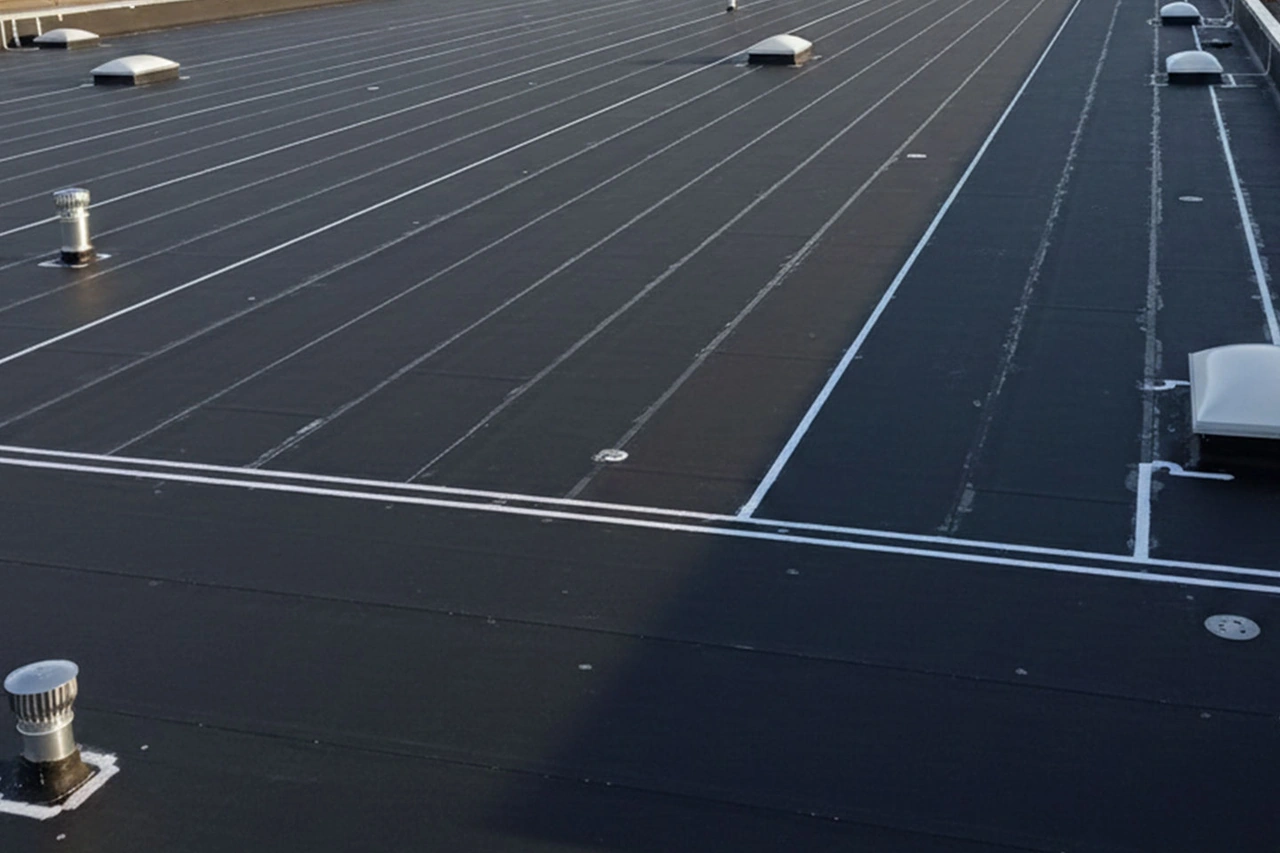
Over time, older adhesive-bonded seams can experience adhesive breakdown, causing laps to lift. Technicians must check for membrane shrinkage, which pulls the rubber away from parapet corners (bridging). EPDM also exhibits surface chalking as it oxidizes under UV light. When localized issues occur, completing a proper rubber flat roof repair with compatible primers, uncured flashing tapes, and lap sealants ensures the membrane remains watertight without introducing incompatible asphalt materials.
TPO and PVC Single-Ply Upkeep
Thermoplastic Polyolefin (TPO) and Polyvinyl Chloride (PVC) membranes feature heat-welded seams that form a continuous physical bond stronger than the membrane itself.
Maintenance for thermoplastic systems centers on:
- Seam Integrity: Probing welded laps to ensure robotic hot-air welds have not experienced false bonding or edge lifting.
- Surface Cleaning: White reflective membranes accumulate airborne dirt, industrial soot, and biological films. Periodic washing with mild non-abrasive detergents restores solar reflectance and keeps rooftop temperatures lower.
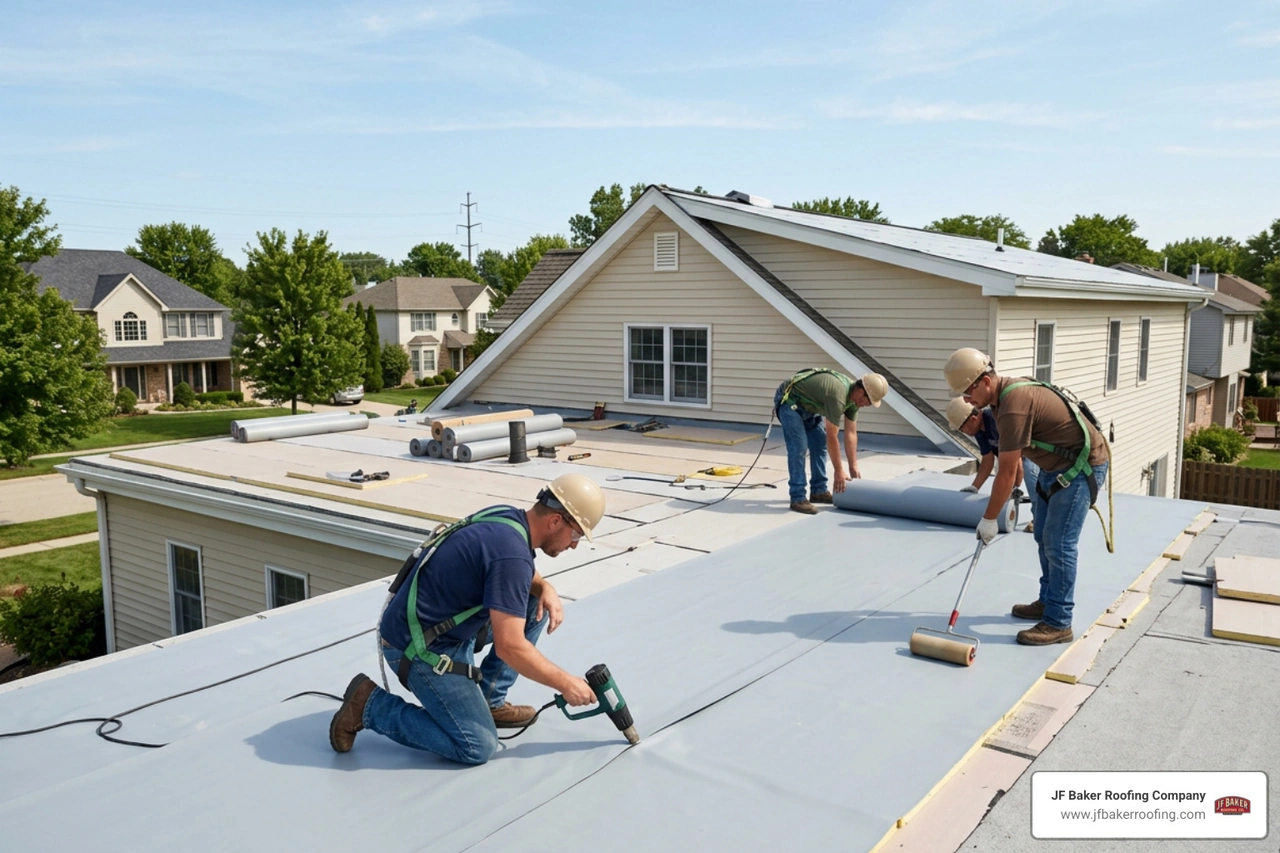
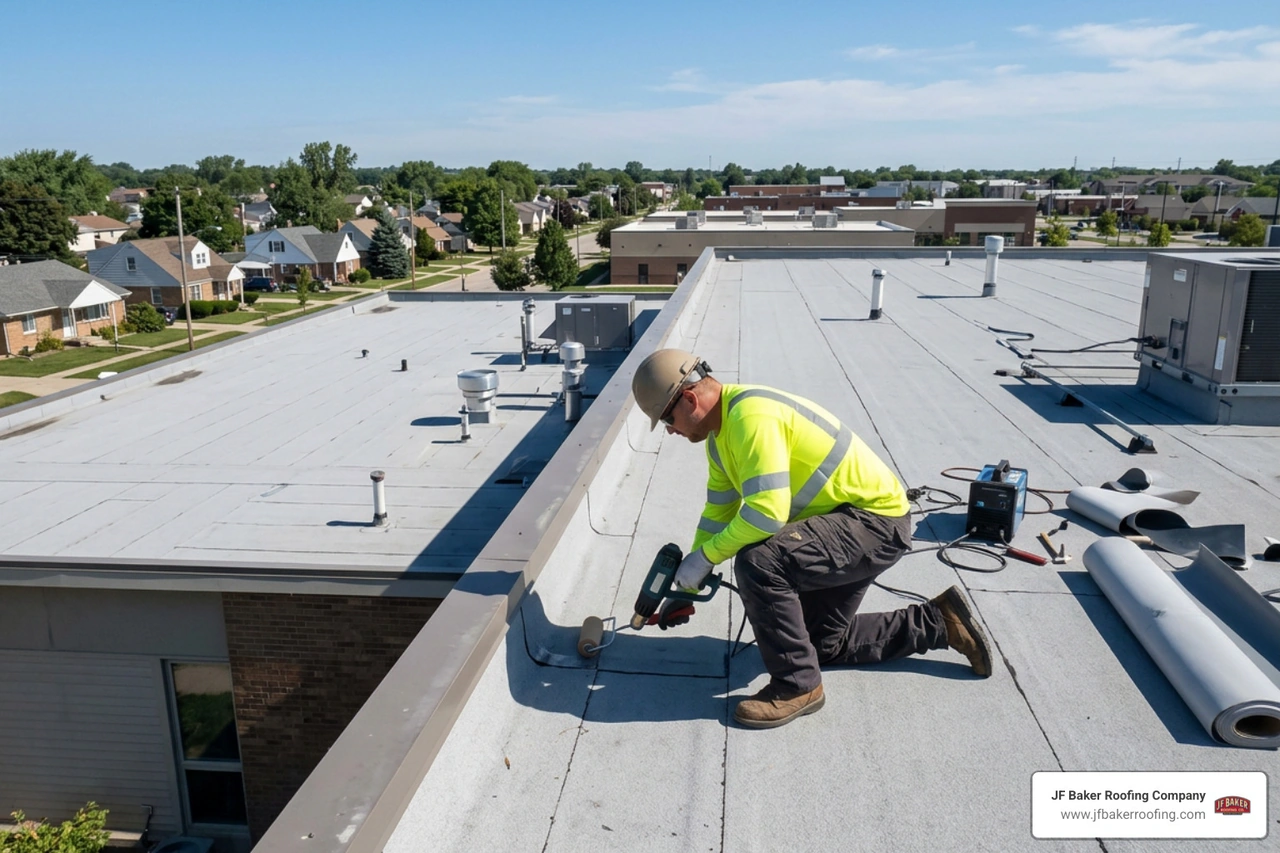
- Puncture Management: Because thermoplastic membranes are reinforced with an internal polyester scrim, cuts or tears require hot-air welding a round-cornered patch made of identical material directly over the damaged area.
Modified Bitumen and Built-Up Roof Care
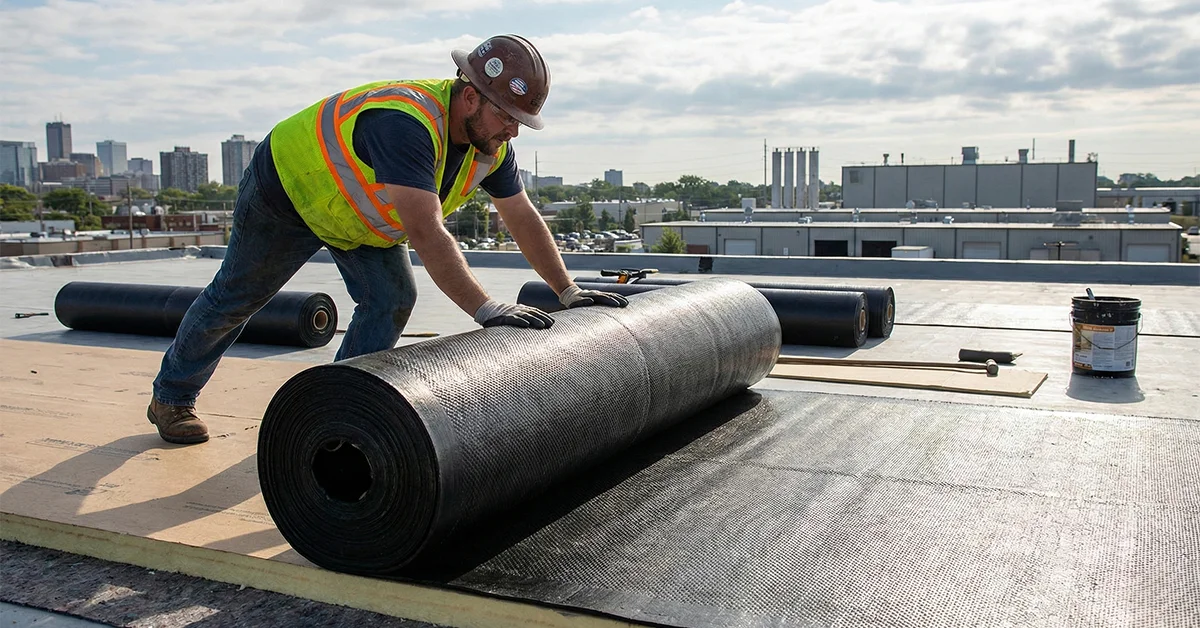
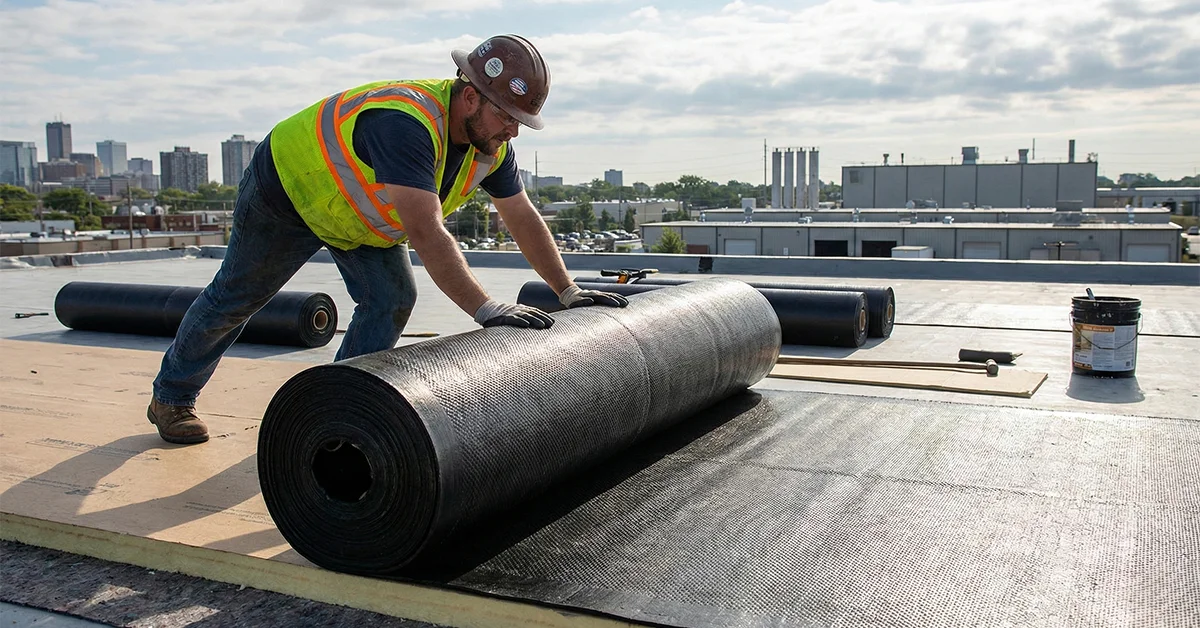
Multi-ply asphalt systems, including Built-Up Roofing (BUR) and Modified Bitumen (Mod-Bit), use multiple layers of reinforcing fabrics bonded with hot asphalt or cold adhesives, often finished with mineral granules or gravel ballast.
Key maintenance steps include:
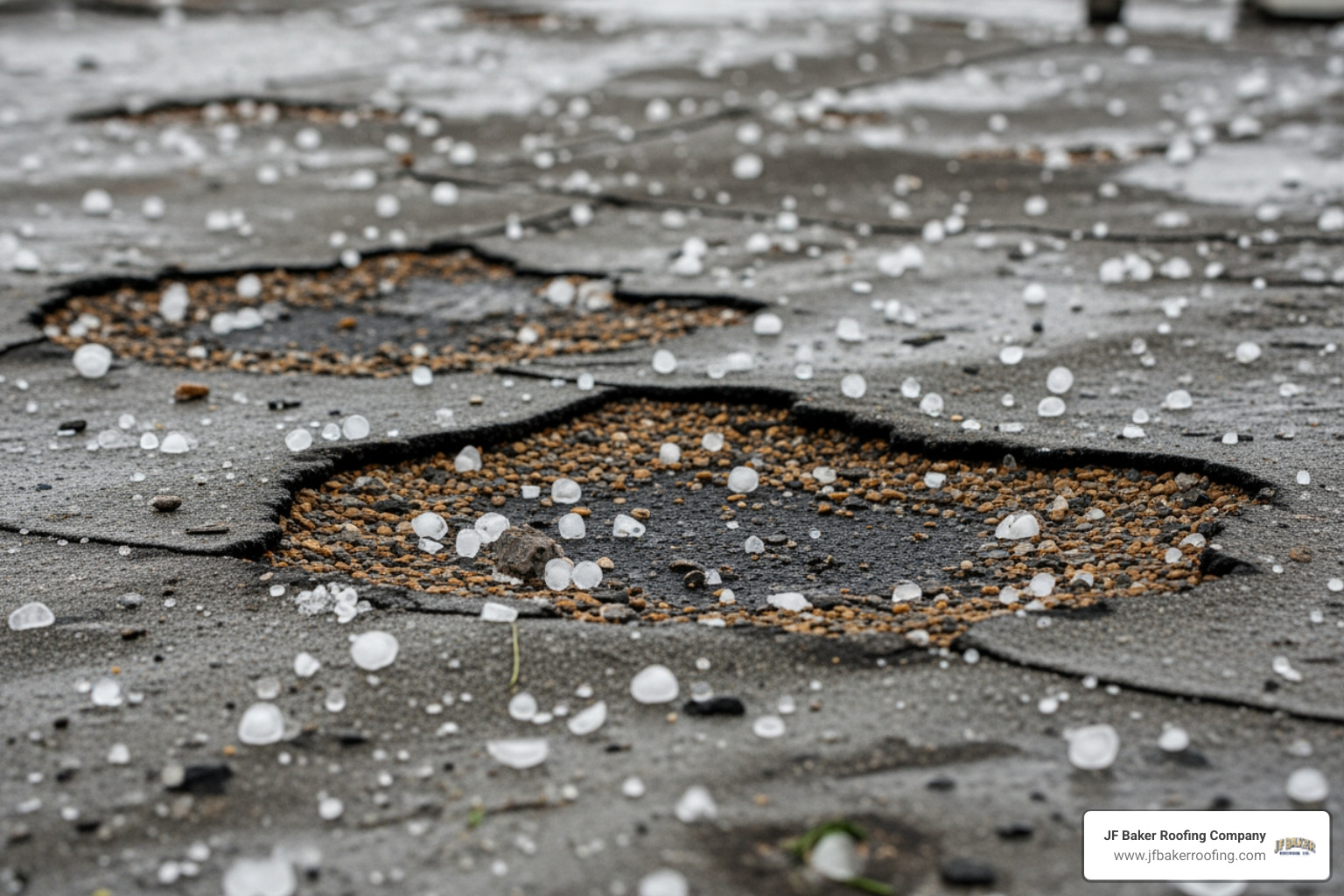
- Granule Loss and UV Protection: Check for bare areas where mineral surfacing has eroded. Exposed asphalt dries out and oxidizes rapidly, leading to alligatoring (surface cracking resembling reptile skin).
- Blister Repair: Trapped moisture or air between plies expands in hot weather, creating raised blisters. Unbroken blisters should be monitored; open or punctured blisters must be sliced, dried, re-adhered, and patched with reinforcing mesh and compatible mastic.
- Reflective Surface Coatings: Applying an elastomeric or aluminum-pigmented roof coating over aging modified bitumen shields the bituminous compound from ultraviolet damage and lowers building cooling loads.
Repair, Retrofit, or Replace: Evaluating Roof Condition
When a commercial flat roof shows widespread wear or moisture intrusion, building owners face a critical decision: should you spot-repair, perform a retrofit overlay, or complete a full tear-off and replacement?
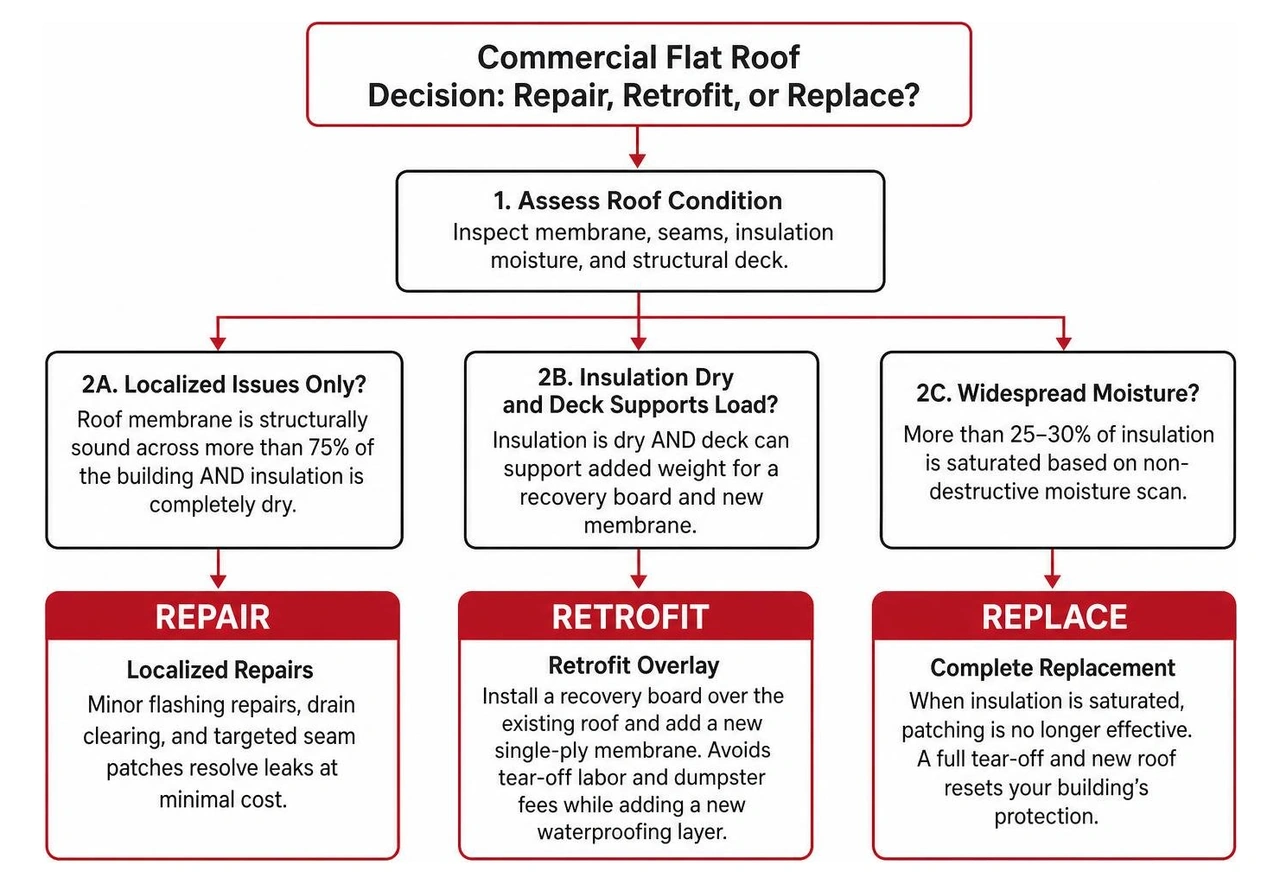
- Localized Repairs: If the roofing membrane is structurally sound across more than 75 percent of the building and underlying insulation is completely dry, localized repairs provide the best return on investment. Minor flashing repairs, drain clearing, and targeted seam patches resolve leaks at minimal cost.
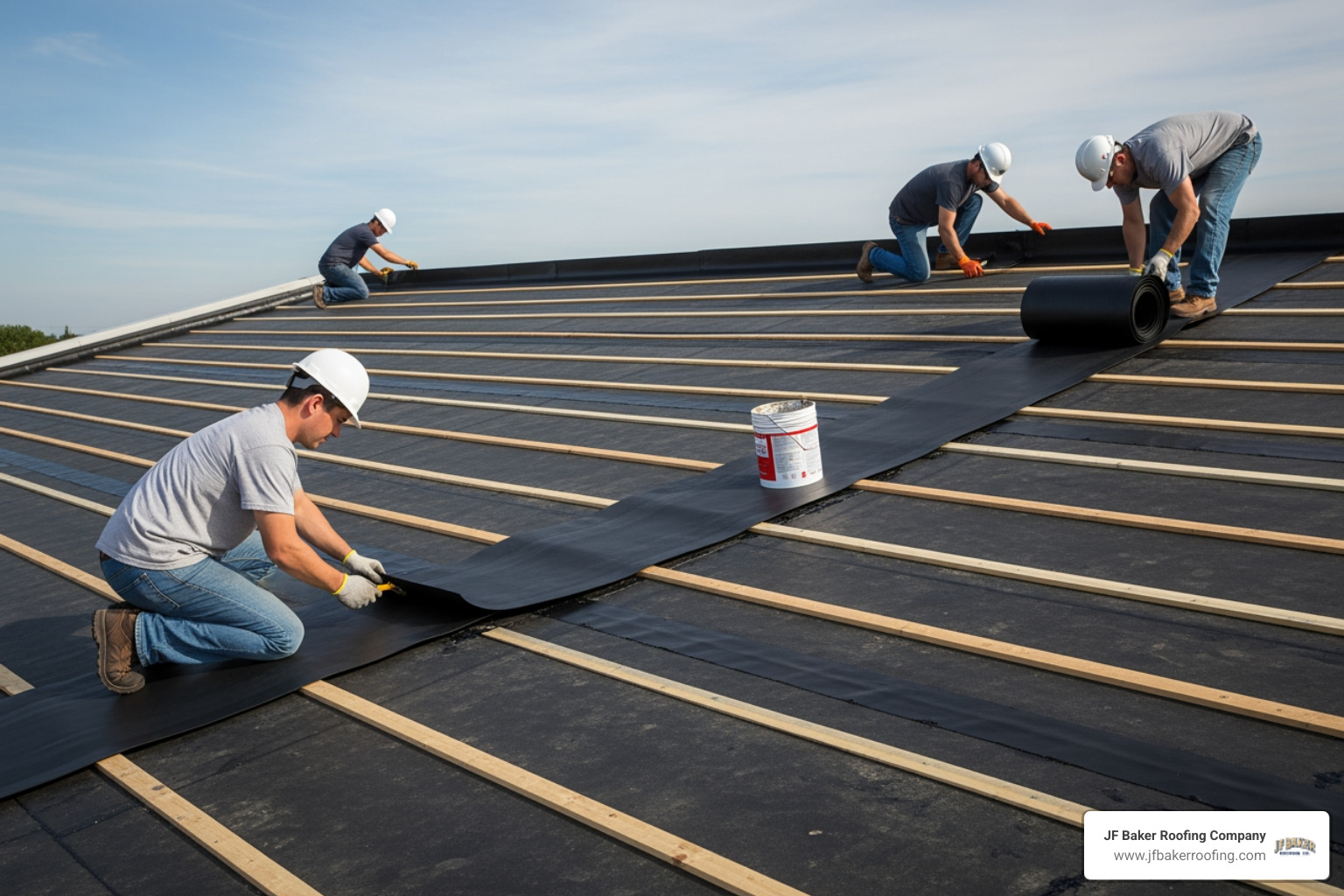
- Retrofit Overlays: If the existing insulation is dry and the deck can support added weight, building codes often permit installing a recovery board over the old roof followed by a new single-ply membrane. Retrofits avoid costly tear-off labor and dumpster fees while delivering a brand-new waterproofing layer.
- Complete Replacement: When non-destructive moisture scans reveal that more than 25 to 30 percent of the insulation core is saturated, patching is no longer effective. Water trapped in the substrate will continue to rust the deck, degrade indoor air quality, and rot structural framing. In these cases, a full tear-off and flat roof installation is the only reliable way to reset your building's protection.
When to Partner with a Professional for Commercial Flat Roof Maintenance
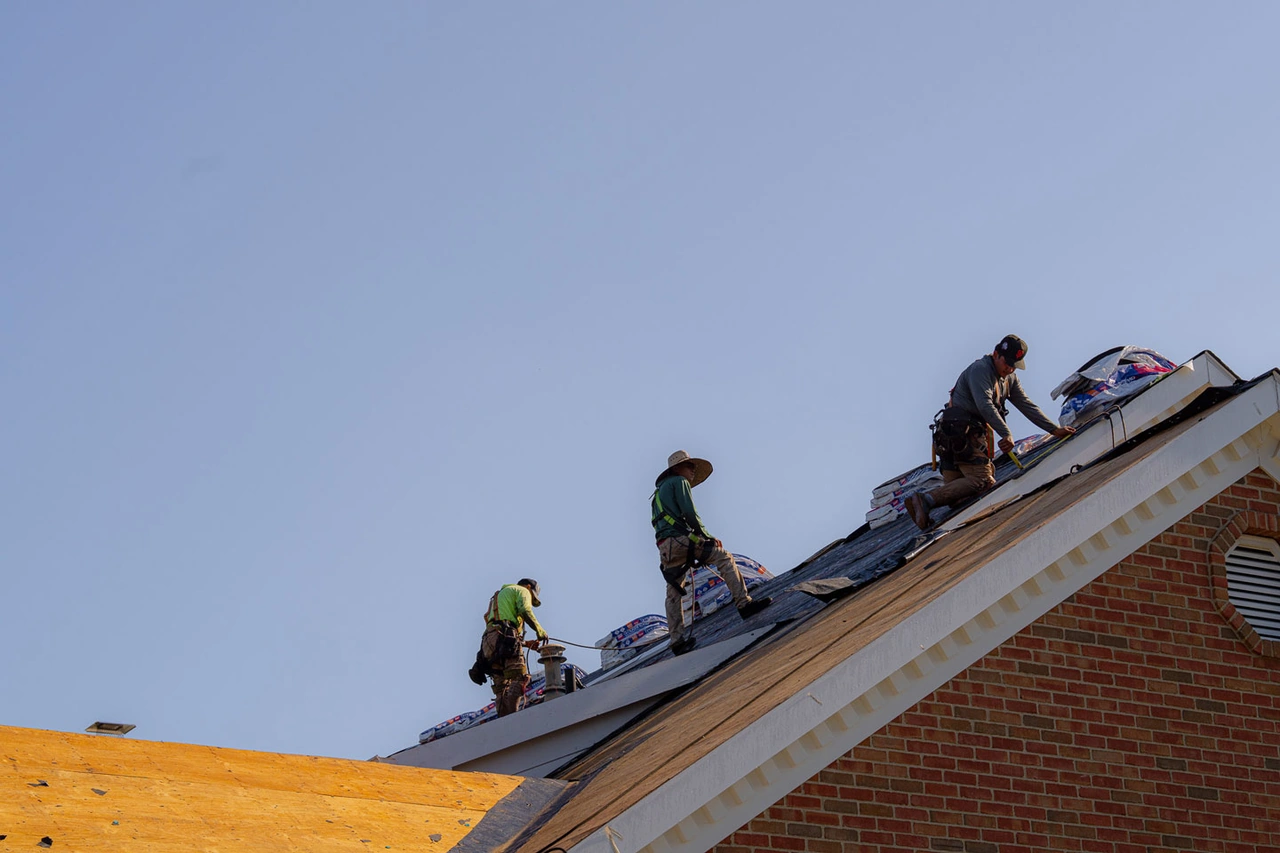
While on-site facility personnel can easily handle basic tasks like clearing surface litter from drain strainers or checking rooftop hatches, comprehensive maintenance belongs in the hands of trained commercial roofers.
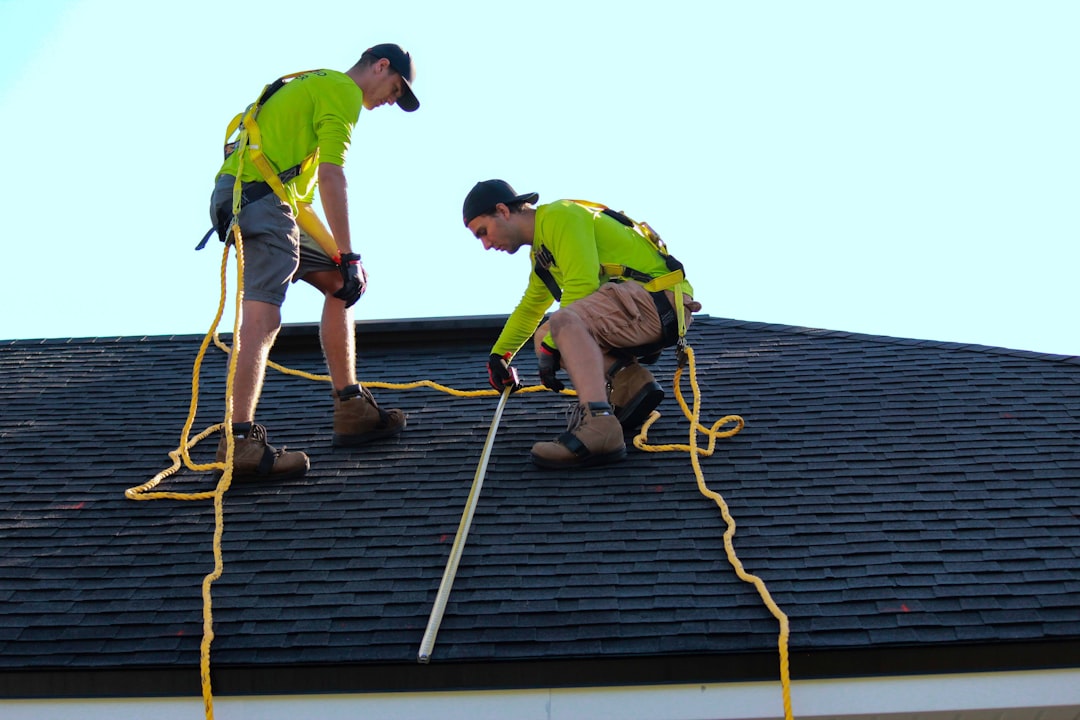
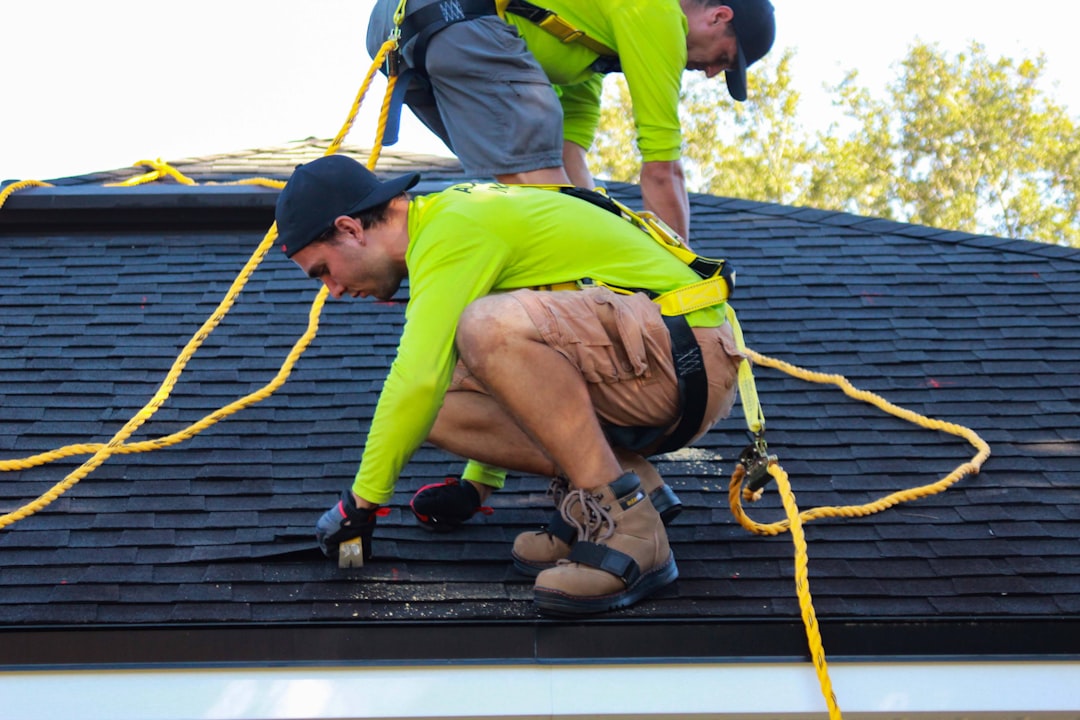
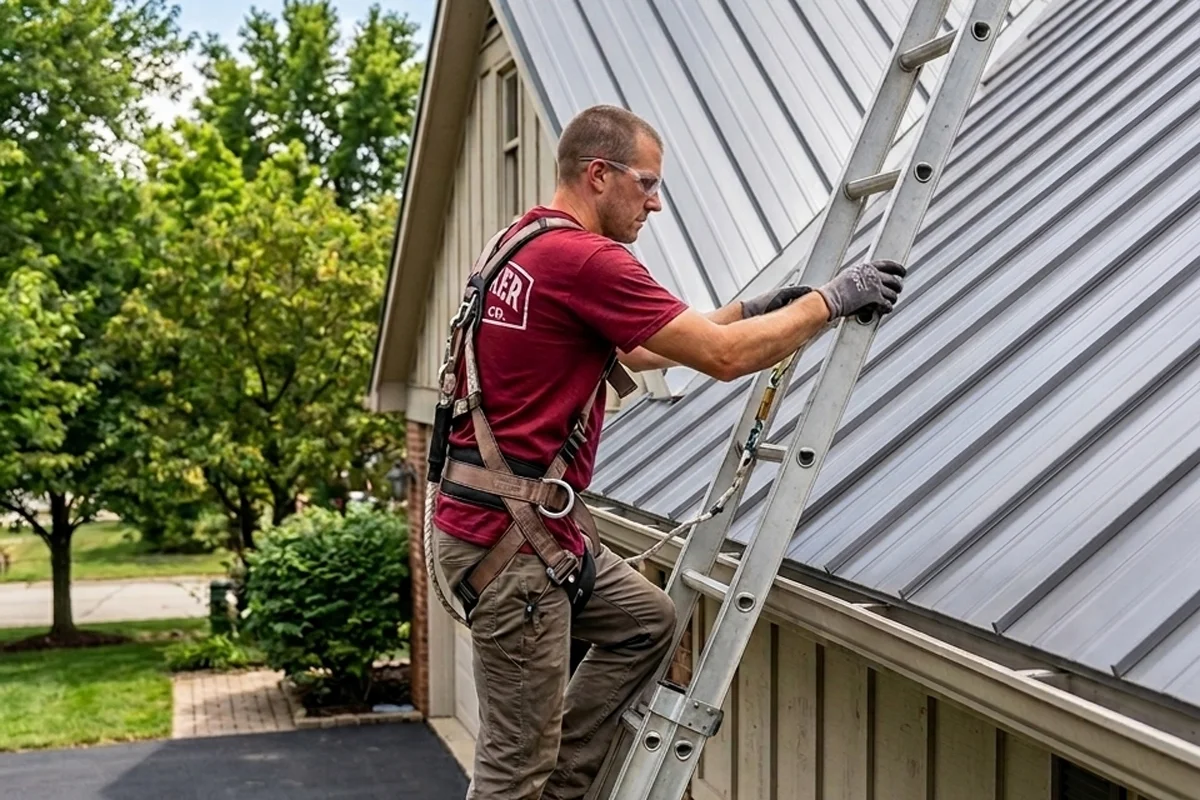
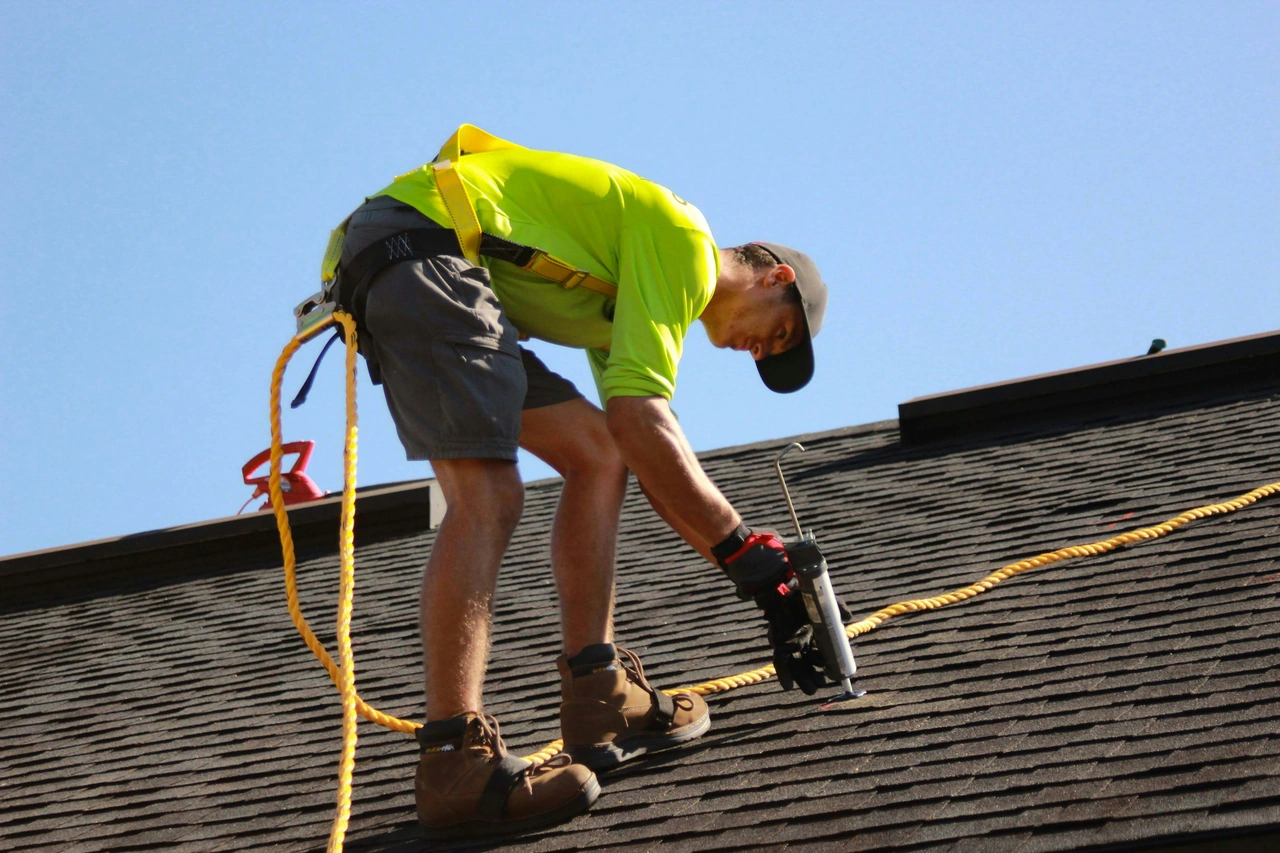
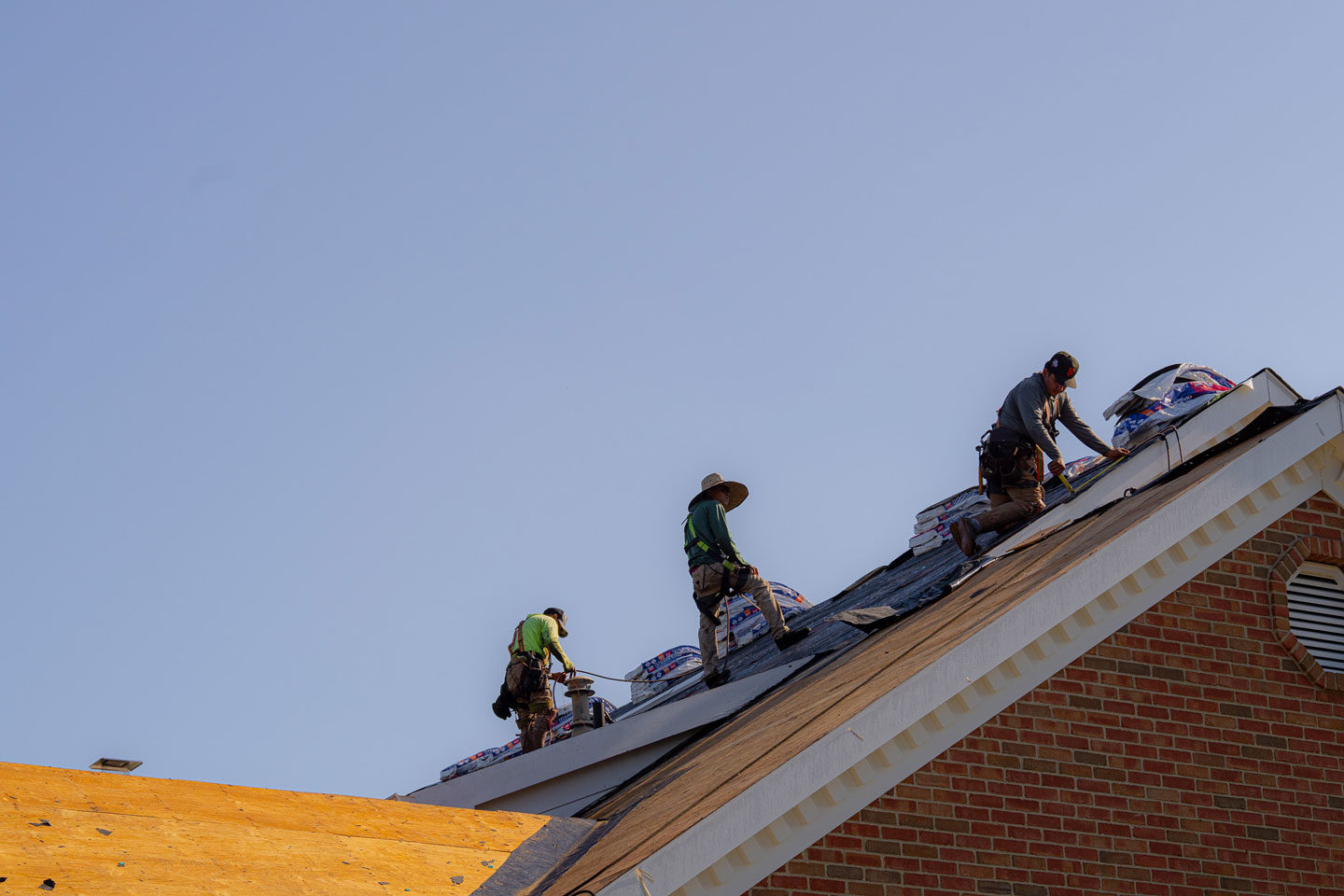
Working on unprotected low-slope roofs requires strict adherence to OSHA fall protection standards, including warning lines, safety monitors, or personal fall arrest systems. Furthermore, using incompatible sealants (such as spreading petroleum-based roofing tar on a synthetic TPO membrane) causes chemical degradation, dissolving the material and immediately voiding factory warranties. Working with an experienced commercial roofing contractor ensures all work meets NRCA specifications and factory warranty requirements.
Frequently Asked Questions About Commercial Flat Roof Care
How often should a commercial flat roof be inspected?
A commercial flat roof should be professionally inspected at least twice a year, once in the spring and once in the fall. In addition, visual assessments should be conducted immediately following severe weather events, such as high-wind storms, heavy hail, or intense freeze-thaw cycles, as well as after any major rooftop mechanical servicing.
What is the primary cause of commercial flat roof leaks?
The primary causes of commercial flat roof leaks are deteriorated edge flashings, failing sealants around rooftop equipment penetrations, and clogged drains that produce ponding water. Physical punctures from uncontrolled rooftop contractor foot traffic and dropped maintenance tools also account for a large percentage of preventable leaks.
Can regular maintenance really extend flat roof lifespan?
Yes. Documented industry studies confirm that regular, proactive commercial flat roof maintenance can extend the operational life of a flat roofing system by 25 to 40 percent. Routine inspections catch small flaws before water saturates internal insulation, avoiding premature deck rot and expensive emergency replacements.
Conclusion
A commercial flat roof is one of the most critical structural components protecting your business, your equipment, and your personnel. Treating low-slope roof upkeep as an ongoing preventive strategy rather than an emergency response lowers total ownership costs, protects manufacturer warranties, and prevents operational disruptions.
At JF Baker Roofing, we have proudly served Central Ohio since 1929. Led by third-generation owners Chad and Pat Baker, our team is an NRCA member, BBB Accredited Business with an A+ rating, and a CertainTeed ShingleMaster Preferred Contractor. Built on integrity and proven by performance, we believe in honest assessments, transparent pricing, and no high-pressure sales tactics. We recommend repairs when repairs suffice and replacement only when genuinely needed, standing behind every roof we install across Columbus, Upper Arlington, Dublin, Westerville, Hilliard, Grandview Heights, Worthington, Gahanna, Bexley, and Whitehall.
Whether your property needs routine seasonal maintenance, custom sheet metal work, drain clearing, or a comprehensive assessment, our professional crews maintain clean job sites and provide clear communication from start to finish. If your property is due for a thorough evaluation, explore our commercial roofing services or contact our team today to schedule an honest roof assessment. Let our reputation be your security.
















.jpeg)